Asian Handicap Explained: Simple Examples for Beginners
Learn the basics of Asian handicap betting with clear examples, helping you make informed wagers and enhance your soccer betting experience.

Asian handicap turns a three-way soccer match into a two-way bet by adding a goal advantage or disadvantage to one team before kickoff, so the draw disappears and every wager settles as a win, a loss, a push, or a split result. BetMzansi covers this market across its bookmaker reviews because it rewards bettors who understand the mechanics, and resources like GambleAware and Wikipedia’s breakdown of the format are worth bookmarking while you learn. Here’s what happens once you place a bet:
- Win: your team beats the handicap.
- Loss: your team fails to cover it.
- Push: the adjusted score ties exactly, and your stake is refunded.
- Half-win/half-loss: quarter lines split your stake between two lines, so you can win half and push (or lose) the other half.
Key Takeaways
Asian handicap works because it converts a three-outcome soccer market into a two-outcome bet through a goal adjustment, letting bettors settle as a win, loss, push, or split result instead of guessing at a draw.
| Point | Details |
|---|---|
| Draw is removed | A goal handicap turns the three-way match market into two outcomes, eliminating draw risk entirely. |
| Line type dictates pushes | Whole-ball lines can push and refund stakes; half-ball lines never push; quarter-ball lines split stakes across two lines. |
| Start simple | Beginners should master 0 (Draw No Bet), +0.5, and -0.5 before attempting quarter handicaps. |
| Check the time frame | Confirm whether a line settles at 90 minutes or includes overtime, since the label changes the outcome. |
| Compare prices before betting | Bet-mzansi’s bookmaker reviews and comparisons help you find the sharpest Asian handicap odds before you stake a wager. |
Table of Contents
- Understanding Asian Handicap: The Core Rules
- Worked Examples for Common Handicap Lines
- Why Bookmakers Offer Asian Handicap and Where the Value Sits
- Checklist Before You Place an Asian Handicap Bet
- Asian Handicap in Overtime and Extra Time
- A Beginner’s Honest Look at Learning Asian Handicap
- Compare Asian Handicap Prices the Smart Way
- Frequently Asked Questions
- Sources
Understanding Asian Handicap: The Core Rules
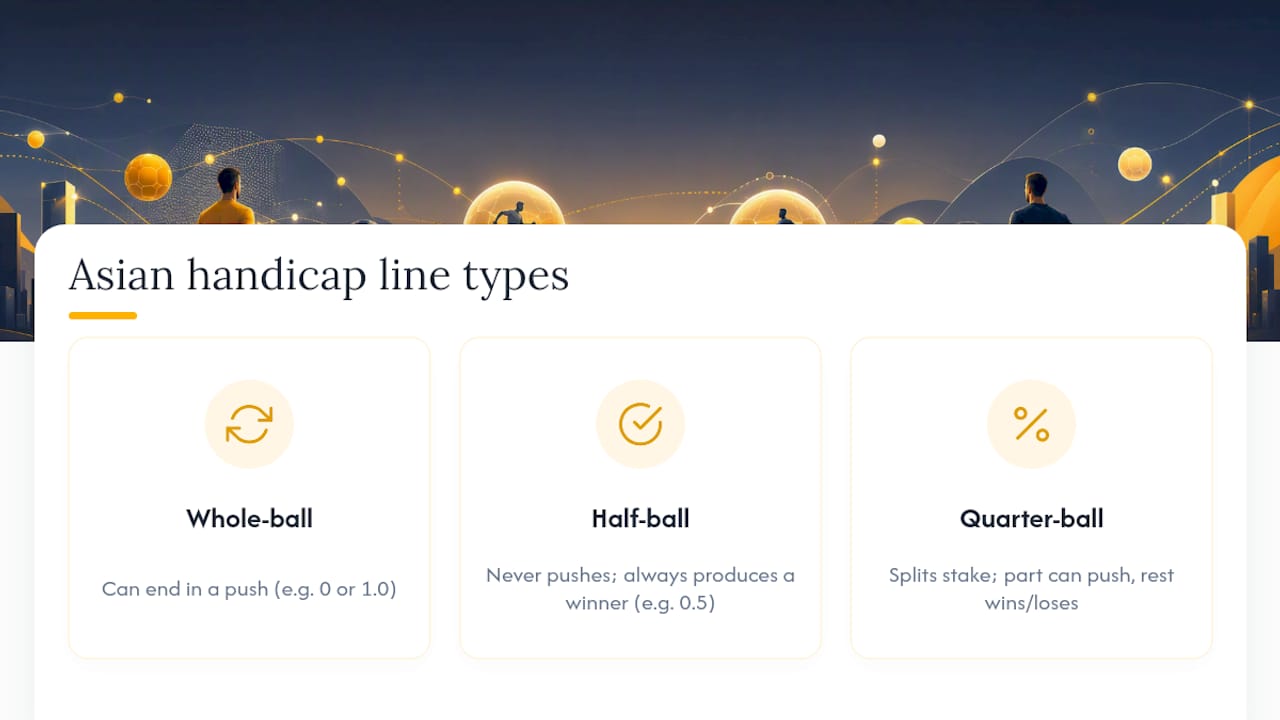
Every Asian handicap line falls into one of three types, and each behaves differently once the final whistle blows. A whole-ball line (like 0 or 1.0) can end in a push. A half-ball line (like 0.5 or 1.5) never pushes; it always produces a winner. A quarter-ball line (like 0.25 or 0.75) actually splits your stake across two adjacent half-lines, which means part of your money can push while the rest wins or loses.
Settlement works in one simple step: add the handicap to the final score, then compare the adjusted scores. If the favorite is at -1.0 and wins 2-1, subtract one goal from their tally, giving an adjusted 1-1. That’s a push, so your stake comes back. Win by two or more and the adjusted score favors you outright.
Picture it as a head start on a scoreboard. The underdog effectively begins the match already ahead by however many goals their handicap grants them, and the final result gets measured against that adjusted baseline rather than the actual scoreline. This single mechanic is what lets Asian handicap markets fold three outcomes (home win, draw, away win) into two.
Pro Tip: Before you place a bet, mentally recalculate the score with the handicap applied. If you can’t quickly say “push,” “win,” or “loss,” you don’t understand the line yet, so don’t bet it.
Worked Examples for Common Handicap Lines
These examples all use the same matchup: a favorite laying the handicap against an underdog receiving it. Watch how the settlement logic shifts as the line moves from flat to a full goal and beyond.
AH 0 (Draw No Bet) This is the simplest line and functionally identical to Draw No Bet, according to beginner-focused guides like Asianodds. If the favorite wins 2-1, that bet wins outright. If the match ends 1-1, both sides get their stake refunded. A 0-1 loss for the favorite means that bet loses.

AH -0.25 / +0.25 (quarter line) Half your stake sits on 0 (Draw No Bet) and half sits on -0.5 for the favorite, per the settlement math Statsbet lays out. A 1-0 favorite win settles both halves as wins. A 1-1 draw pushes the DNB half and loses the -0.5 half, so you get back half your stake and lose the other half, a net half-loss. A 0-0 draw does the same in reverse for the underdog bettor: half push, half win.
AH -0.5 / +0.5 (half-ball line) No pushes here, ever. Favorite wins by any margin, that bet cashes. Draw or underdog win, that bet loses outright. It’s the cleanest line on the board precisely because it can’t tie.
AH -0.75 / +0.75 (quarter line) Half your stake rides on -0.5 and half on -1.0. A 2-0 favorite win settles both halves as wins, a full win. A 1-0 win settles the -0.5 half as a win and the -1.0 half as a push, netting a half-win. A draw loses both halves.
AH -1.0 / +1.0 (whole-ball line) The favorite must win by two or more goals to cover outright. Win by exactly one goal, like 2-1, and the bet pushes, Goal. Win by one goal to nil, still a push. Draw or lose, that bet loses.
AH -1.5 / +1.5 (half-ball line) The favorite needs a two-goal margin or better. A 3-1 win covers. A 2-1 win falls one goal short and loses the bet. On the flip side, +1.5 for the underdog wins if they draw, lose by exactly one goal, or win outright, which is why this line is popular with bettors backing underdogs to stay competitive rather than win.
Why Bookmakers Offer Asian Handicap and Where the Value Sits
Cutting the draw out of the equation compresses the market from three outcomes to two, and that compression typically lowers the bookmaker’s overall margin compared with a standard 1X2 market. Fewer outcomes to price means less margin baked into each side, which is part of why sharper bettors gravitate toward these markets in search of better value than what straight 1X2 pricing offers.
Expect odds to sit close to even money on well-matched lines, often somewhere around 1.85 to 1.95, since the handicap is doing the work of balancing the two sides rather than the price. When a line moves before kickoff, whether from -0.5 to -0.75 or the reverse, it usually signals where informed money is landing, and that shift is worth more attention than the price itself.
A few practical habits pay off here:
- Compare the same line across multiple bookmakers before betting; margins vary more than bettors expect.
- Track pre-match line movement rather than betting the moment you see a number.
- Remember that a push on one leg of an accumulator voids that leg and recalculates the remaining odds, rather than killing the whole ticket the way a loss would.
Checklist Before You Place an Asian Handicap Bet
Run through this before you commit money to a line:
- Confirm the market type. Asian handicap and European handicap settle differently. European handicap allows a three-way result (including a draw on the adjusted score); Asian handicap does not.
- Pick the right line for your view. A whole or half number if you want a clean win/loss, a quarter number if you want to express a nuanced opinion between two lines.
- Shop the price. The same handicap can carry different odds at different bookmakers.
- Size your stake to your bankroll, not to how confident you feel about one match.
- Check for late-breaking news. A key injury announced an hour before kickoff can justify moving from -0.5 to -0.25 on the favorite, since a weakened attack might not cover a full half-goal.
If you’re new to reading these lines, start with 0, +0.5, or -0.5 before touching quarters, a sequence beginner guides consistently recommend for good reason. Betting is entertainment, not income, so treat losses as the cost of that entertainment and use GambleAware if wagering ever stops feeling like fun.
Pro Tip: Keep a simple spreadsheet of which lines you bet and how they settled. After twenty or thirty bets, you’ll see exactly which lines you understand and which ones you’re still guessing on.
Asian Handicap in Overtime and Extra Time
Asian handicap markets on regular football matches almost always settle at the end of 90 minutes plus stoppage time, ignoring any extra time or penalty shootout that follows in knockout competitions. If you bet a Champions League knockout match at -0.5 and the score is tied after 90 minutes, that bet loses regardless of what happens in extra time, unless the specific market was explicitly labeled to include it.
Bookmakers typically list two separate markets for cup matches: one for “regular time” or “90 minutes” and another for “including overtime” or “full match.” Always check which version you’re backing, since the settlement outcome can flip entirely depending on that label. A -1.0 handicap that pushes at 90 minutes on a 1-0 lead could still lose if extra time changes the aggregate score and you’d actually bet the full-match version.
Other sports handle this differently. Basketball and American football handicaps, for instance, commonly include overtime in the settlement by default, since those extra periods are considered part of the same competitive result rather than a separate knockout mechanism. Ice hockey often splits the difference, with some books settling regulation-only lines and others rolling in overtime and shootouts.
The safest habit, regardless of sport, is reading the market label before you bet, not after. A single word, “regulation” versus “full time,” changes what your handicap is actually measuring.
A Beginner’s Honest Look at Learning Asian Handicap
Most beginners don’t struggle with whole or half lines. They struggle with quarters, because it’s genuinely counterintuitive that a single bet can split into two separate outcomes. I’ve seen bettors place a -0.25 wager expecting a clean win or loss, then get confused when their bet slip shows a half-refund. That confusion is normal, and it usually clears up after two or three settled quarter bets, not after reading another explainer.

The other common mix-up is treating Asian handicap and European handicap as interchangeable because they sound similar. They’re not. If you’re still building that mental model, spend a few weeks on Draw No Bet, plain +0.5/-0.5 lines, and -1.0/+1.0 before touching a quarter line with real money. Keep stakes small while you’re still translating scorelines into adjusted scores in your head; the market rewards patience more than confidence.
Compare Asian Handicap Prices the Smart Way
Line shopping is where Asian handicap bettors actually make their money, and doing it manually across a dozen bookmaker apps wastes time you could spend on match research instead. BetMzansi consolidates licensed South African bookmaker odds and reviews in one place, so instead of hunting for the sharpest -0.5 or +0.25 price yourself, you can see how providers stack up side by side.

Start with the Best Betting Sites in South Africa comparison to find a licensed operator with strong Asian handicap coverage on the leagues you follow, or check a specific provider like the World Sports Betting review for its market depth before signing up. If you want the mechanics to stick before you commit real stakes, the betting glossary breaks down related terms like Draw No Bet in plain language. Betting is entertainment, and if it stops feeling that way, BeGambleAware offers free, confidential support.
Frequently Asked Questions
What does a push mean in Asian handicap betting? A push means the adjusted score ties exactly, so your stake gets refunded in full. It happens only on whole-ball lines like 0, 1.0, or 2.0, never on half-ball lines.
Is Asian handicap the same as Draw No Bet? AH 0 is functionally identical to Draw No Bet. Both refund your stake if the match ends level and settle as a straight win or loss otherwise.
Why do quarter handicaps exist if they’re confusing? Quarter lines let bookmakers price matches with more precision between two half-lines, giving bettors a way to express a view that sits between a 0.5 and a 1.0 handicap rather than rounding to one or the other.
Does Asian handicap apply to sports other than soccer? Yes, though settlement rules around overtime vary. Basketball and American football often include overtime in the result automatically, while soccer typically settles at 90 minutes unless the market states otherwise.
How is Asian handicap different from 1X2 betting? 1X2 offers three outcomes (home win, draw, away win) and prices the draw as a live possibility. Asian handicap removes the draw through a goal adjustment, leaving only two outcomes to bet on.
Sources
This explainer draws on Wikipedia’s Asian handicap overview, Goal.com’s betting guide, Statsbet’s settlement breakdown, and Online-betting.org’s UK guide. For support with gambling habits, visit GambleAware, or explore more explainers on BetMzansi’s Learn hub.