Both Teams to Score Meaning: BTTS Explained Simply
Discover the meaning of 'both teams to score' in betting. Learn how to place bets effectively and understand payout conditions.

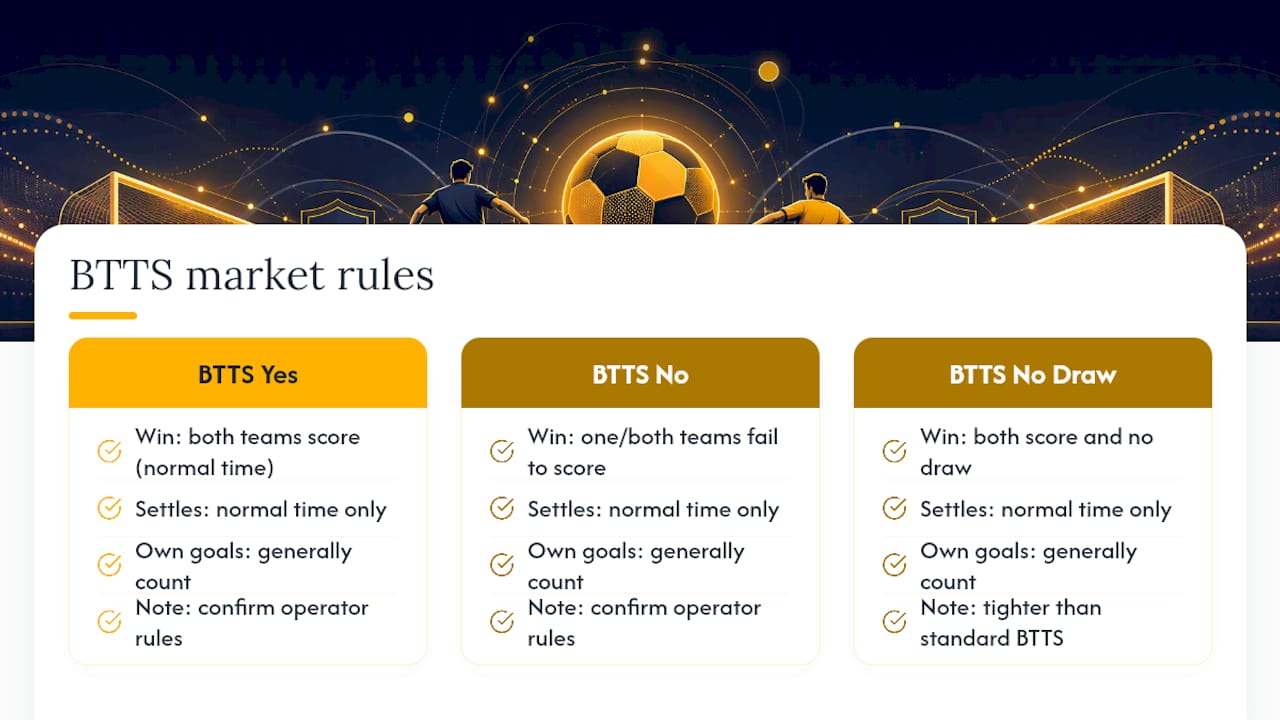
“Both teams to score” (BTTS) means you’re betting on whether each team will find the net at least once, regardless of who wins. BTTS Yes wins if both sides score during the match’s normal 90 minutes plus stoppage time. BTTS No wins if one or both teams fail to score. Extra time and penalties usually don’t count, and combined markets or bet builders carry their own settlement quirks, so always check the displayed market rules before you stake a cent.
Key Takeaways
BTTS Yes pays out whenever both teams score during normal time, regardless of the final result, and understanding this single rule prevents most common betting mistakes.
| Point | Details |
|---|---|
| BTTS ignores the winner | Both teams to score cares only about each side scoring, not who wins or the final margin. |
| Normal time settlement | Extra time and penalties usually don’t count; always confirm the operator’s displayed rules. |
| Check recent form and H2H | Goals scored/conceded and head-to-head history reveal stable scoring patterns worth trusting. |
| Accumulators multiply risk | Every leg in a combined bet must win, so a single clean sheet kills the entire ticket. |
| Bankroll discipline matters | Size stakes sensibly, avoid oversized accas, and set loss limits before you start betting. |
Table of Contents
- What Does Both Teams Score Mean in Betting?
- How Do You Calculate a BTTS Payout?
- What Are the Different Types of BTTS Bets?
- How Do You Predict BTTS Correctly?
- How Often Does BTTS Actually Happen?
- What Should You Watch Out for Before Betting BTTS?
- Frequently Asked Questions
- Sources
What Does Both Teams Score Mean in Betting?
BTTS Yes and BTTS No are the two sides of this market, and you’ll see that exact phrasing on nearly every sportsbook slip. The scoreline itself doesn’t matter for settlement purposes. A 4–1 thriller and a scrappy 1–1 draw both pay out on BTTS Yes, because both teams scored at least once in normal time. A 3–0 win doesn’t, no matter how dominant the performance looked.
That’s what separates BTTS from a result bet or a totals market. Over/under 2.5 goals cares about the combined tally. A 1–1 draw satisfies BTTS Yes but fails an Over 2.5 bet outright, since only two goals were scored in total. BTTS asks a narrower, simpler question: did each side get on the scoresheet, not who scored more or how many total goals hit the net.
You’ll find this market almost everywhere football is offered. Full-time BTTS is the standard version, but sportsbooks also run first-half BTTS, and BTTS shows up constantly inside bet builders and accumulators. Its simplicity is a big part of why it’s stayed popular with beginners and sharp bettors alike.
How Do You Calculate a BTTS Payout?
The math behind a BTTS bet works the same as any straight wager. Here’s how a single and a short accumulator play out.
- You stake $10 on BTTS Yes at odds of 1.80 (decimal) for a match between two attacking sides. If both teams score, you collect $18 total, which is your $10 stake plus $8 profit.
- You build a three-leg accumulator: BTTS Yes at 1.80, a separate match result at 2.10, and another BTTS Yes at 1.75. A $10 stake multiplies through all three odds (1.80 × 2.10 × 1.75 = 6.615), returning $66.15 if every leg wins.
- Adding a BTTS leg to an accumulator raises the potential payout, but it also raises risk. Every leg in a combined bet must land for the whole ticket to pay out. One clean sheet anywhere in the chain and the acca is dead.
Before locking in any multi-leg slip, confirm each BTTS leg settles on normal time only. Extra time drama in a cup match won’t rescue a losing leg if the operator excludes it.
What Are the Different Types of BTTS Bets?
Full-time BTTS is the default and covers the entire 90 minutes plus stoppage time. First-half BTTS only counts goals scored before the halftime whistle, which is a much tighter window and generally a tougher bet to win since fewer goals go in during the opening 45 minutes.
Bet builders let you stack BTTS Yes alongside other selections, like a specific player to score or a total-goals line. Combining markets changes the event conditions entirely. If you build a BTTS Yes plus Over 2.5 Goals bet, a 1–1 draw pays out on the BTTS half but fails the goals total, sinking the whole builder.
Accumulators treat BTTS as just one leg among several, standing or falling with every other selection on the ticket. Operator rules vary on edge cases too. What counts as a goal, how abandoned matches settle, and whether own goals count toward BTTS can differ from one bookmaker to the next, so it pays to skim the betting glossary for any site you’re using before you commit real money.
How Do You Predict BTTS Correctly?
Good BTTS prediction is less about gut feeling and more about running through a short checklist before kickoff. Here’s what experienced bettors actually look at.
- Recent scoring form. Check each team’s goals scored and conceded over their last five to ten matches, home and away splits separately.
- Head-to-head history. Look for stable patterns like repeated 1–1 or 2–2 results between the same two sides, which often point to comparable attacking and defensive levels.
- Playing style. Teams that press high and leave gaps behind them tend to concede more, which favors BTTS Yes when they face another side that can finish chances.
- Injuries and suspensions. A missing starting striker or a backup center back filling in can swing goal expectancy in either direction.
- Lineup news. Confirmed team sheets, usually released 60 to 90 minutes before kickoff, often reveal rotation or rest decisions that stats alone won’t show.
- Manager tactics and game context. A must-win relegation battle plays very differently than a mid-table game with nothing on the line; cup ties sometimes see weakened lineups.
Lean toward BTTS No when you’re watching two defensively disciplined sides, a team on a long scoring drought, or a match facing heavy rain or wind that tends to suppress open play. Lean toward BTTS Yes when both teams favor attacking football and have shaky defenses, especially in leagues known for looser structure.
Pro Tip: Wait until confirmed lineups drop before finalizing your BTTS pick. A key striker ruled out an hour before kickoff can flip the entire calculation, and checking a prediction guide alongside team news gives you a sharper read than stats alone.
How Often Does BTTS Actually Happen?
BTTS outcomes show up constantly at the top level of football. In the 2024–25 Premier League season, the scoreline 1–1 occurred in 11.85% of matches, 2–1 in 9.63%, and 2–2 in 7.78%. Stack those three scorelines alone and you’ve got roughly three in ten matches settling BTTS Yes just from those outcomes, before counting every other scoreline where both teams got on the board.
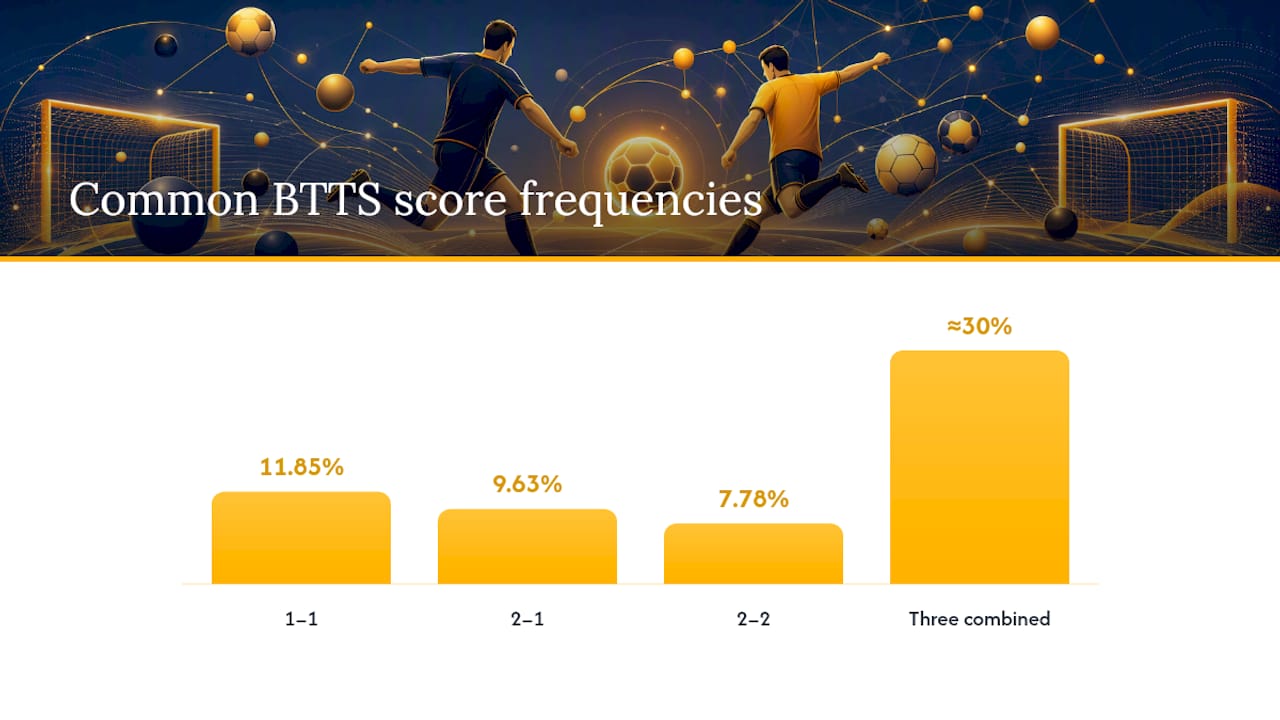
That frequency explains why BTTS remains one of the most heavily bet markets in football. It’s not a long-shot novelty bet; it’s close to a coin flip in many competitive leagues, which is exactly why bookmakers price it carefully and why sharp bettors treat it as a genuine analytical exercise rather than a hunch.
The catch is that this figure describes one league in one season. Lower-scoring leagues, cup competitions with defensive tactics, or teams in a mid-season slump can all shift these numbers substantially. Treat any statistic like this as a starting probability, not a guarantee.
What Should You Watch Out for Before Betting BTTS?
BTTS looks straightforward, but a few things trip up even experienced bettors.
- Bookmaker margins mean the odds you’re offered are never quite the “true” probability. The house always builds in a cut.
- A single low-scoring team, or a manager who parks the bus in a big match, can silence an otherwise reliable BTTS pattern overnight.
- Head-to-head records built on three or four matches are a small sample and can mislead you far more often than they help.
- Own goals typically count toward BTTS, but confirm this with your operator since rules can vary.
- Abandoned matches and extra time in cup ties usually void or exclude the extra period from BTTS settlement, so read the market terms first.
- Keep individual stakes small relative to your total bankroll, avoid piling five or six legs into a single accumulator just to chase a bigger payout, and set a firm loss limit before you start betting for the day.
A Quick Note From Nkosi
I’ve spent enough time around South African bettors to know BTTS gets misunderstood constantly. BetMzansi built its glossary and prediction guides specifically to close that gap, one clear explanation at a time.
Ready to put this into practice? Compare the sportsbooks that offer the clearest BTTS market rules and the strongest football coverage on our guide to South Africa’s best betting sites, or brush up on the fundamentals first with our betting strategy basics for beginners.
Frequently Asked Questions
How do you win a BTTS bet? You win BTTS Yes when both teams score at least one goal during the match’s normal time. You win BTTS No when one or both teams fail to score.
What does “yes” mean on a bookmaker like Betway? On most sportsbooks, including Betway, selecting “Yes” on the BTTS market means you’re predicting both teams will score during normal time. It settles the same way across most licensed operators, though it’s worth confirming the specific terms listed on your bet slip.
Do extra-time goals or own goals count toward BTTS? Extra time and penalty shootouts are usually excluded from BTTS settlement, with the market settling on normal time only. Own goals generally count toward the team that benefits from them, but this can vary slightly by operator, so check the market rules before staking.
What does “both teams to score, no draw” mean? This combines two separate conditions in one bet: both teams must score, and the match cannot end in a draw. It’s a tighter combined market than standard BTTS Yes, since a 1–1 or 2–2 result would satisfy the scoring condition but fail the “no draw” half, voiding the entire bet.
What is a BTTS bet in simple terms? It’s a wager on goal participation from both sides, not the scoreline or the winner. If you’re new to betting terminology generally, BetMzansi’s betting glossary breaks down dozens of similar terms in plain language.
Sources
- Both teams to score betting
- Goal
- Both teams score betting explained | Sporting News (April 28, 2026)
- BTTS Meaning: What It Means in Betting | SportSignals