Avoid Losing 10–20% on Cash Outs: Rules for South African Bettors
Practical cash out guide for South African casual bettors. Learn how offers are priced, run a quick fair value check, and avoid 10–20% repeated losses.

Cash out lets you settle an open bet immediately for a set amount, closing it before the event ends. Once you confirm the offer, the actual result stops mattering. You get a fixed payout right then, but that number is almost always a little below what you’d win if you let the bet ride and it landed. The gap is the bookmaker’s cut for taking on your risk early.
TL;DR:
- Cash out offers are calculated from live odds minus the bookmaker’s margin, usually below the true expected value to include their profit.
- Using cash out is advisable only when a significant game change, like an injury or red card, occurs, not for temporary score swings or nerves.
- Refunds are typically processed within seconds for successful cash outs, but market suspensions or restrictions can cause requests to fail or delay.
- Bonus-funded bets often limit cash out to profits only, and promotional boosts may be voided if cashed out early, affecting potential returns.
- Relying on cash out frequently incurs the bookmaker’s margin costs, which can erode long-term profits if used reflexively rather than strategically.
Table of Contents
- How Does Cash Out Work?
- What Are the Types of Cash Out: Full, Partial, and Auto?
- When Should You Use Cash Out?
- How Do You Cash Out and Fix Common Problems?
- How Do Bonuses and Promotions Change Cash-Out Offers?
- What Are the Long-Term Risks of Cashing Out Too Often?
- A Simple Rule for Using Cash Out Wisely
- Learn More Before Your Next Bet
- Where to Get Official Help and Support
- Sources
How Does Cash Out Work?
A cash-out offer isn’t pulled from thin air. It’s built from the live odds on your bet’s market at that exact moment, converted into an implied probability of winning, then reduced by the bookmaker’s margin. That margin, often called the vig, is baked into every live price you see, and it’s what keeps the offer below the bet’s true expected value. OddsShopper’s explainer on cash-out mechanics breaks this down clearly: you’re not just trading time for certainty, you’re paying a fee to do it.
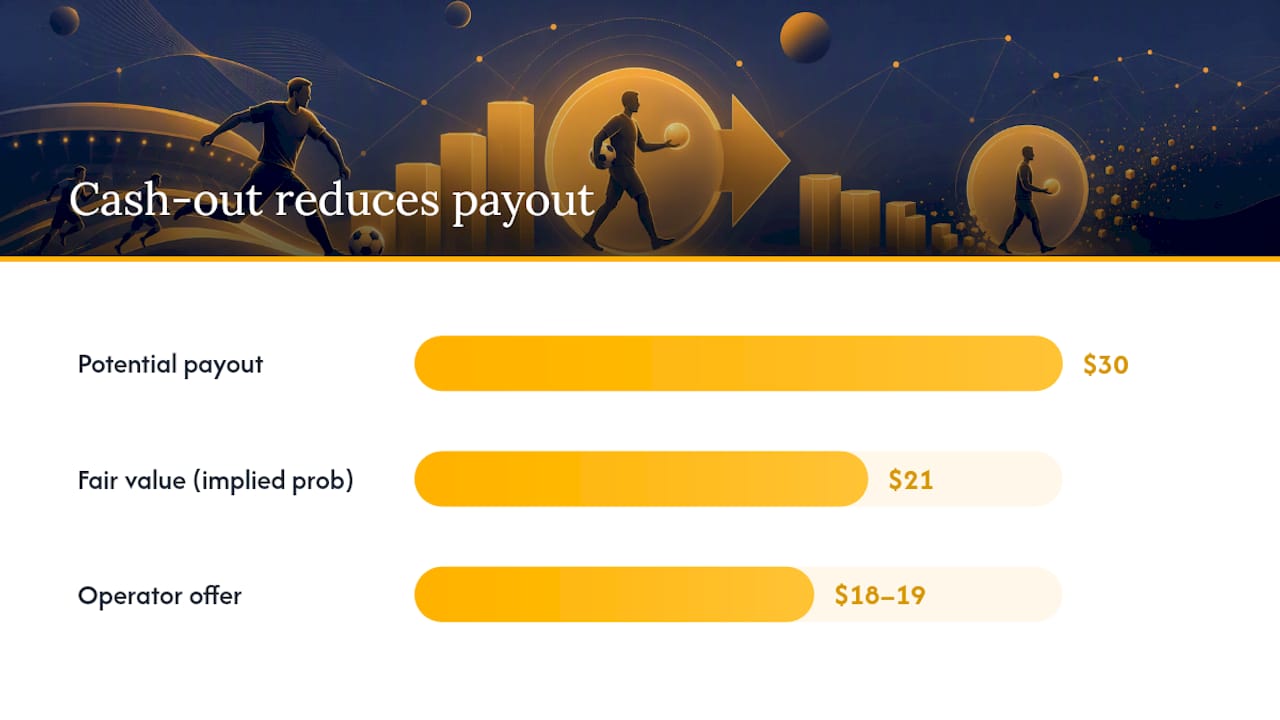
Here’s a simplified worked example. Say you backed a team at odds of 3.00 (a $10 stake, $30 potential payout) and they’re now leading with 20 minutes left. Multiply 0.70 by your $30 payout and you get a fair value of roughly $21. The actual cash-out offer on your screen might read $18 or $19, because the operator has shaved off its margin.
Offers move fast, and sometimes vanish entirely. A goal, a red card, an injury, or a market getting suspended for review can all yank the offer off your screen without warning. GotTheOdds’ cash-out guide notes that the amount reflects the current likelihood of your bet winning, which is exactly why it shifts every few seconds during a live match.
Two things worth knowing about what happens after you tap “confirm”:
- A successful cash out usually credits your wallet within seconds, not hours.
- An unsuccessful request, one that fails because the market froze at the wrong moment, typically gets rejected and your bet stays live at its original terms.
What Are the Types of Cash Out: Full, Partial, and Auto?
Not every cash-out button does the same job, and knowing the difference stops you from clicking the wrong one mid-match.
- Full cash out closes the whole bet for the offered amount. Your ticket is done, no further outcome affects you either way.
- Partial cash out lets you pull out a slice of your potential return while leaving the rest of the stake running. This is especially handy on accumulators, where you might want to lock in some profit but keep chasing the bigger payout on remaining legs, a tactic Betting flags as common practice for multi-leg bets.
- Auto cash out lets you set a target value in advance, and the system executes automatically once the offer hits that number. Useful if you know you’ll want to lock in profit at, say, $50 but won’t be watching the screen when it happens.
When Should You Use Cash Out?
Cash out earns its place in your toolkit in a handful of specific situations, not as a default habit.
Take it when something genuinely changes the game: a star player gets injured, a red card flips the odds, or your accumulator’s remaining risk is bigger than you’re comfortable carrying. It also makes sense if you spot a clear staking error right after placing the bet.
Skip it when you’re just nervous about a temporary dip, when the scoreline swings back and forth without changing the underlying picture, or when you had genuine value at the odds you placed. Cashing out of a bet you correctly priced at the start is usually giving away edge for no good reason.
Before accepting any offer, run a rough fair-value check. Convert the live odds to implied probability, strip out the overround, then multiply that number by your potential payout, a method OddsShopper details step by step. If the cash-out figure sits well below that fair value, you’re paying a steep price for certainty.
- Ask whether the situation has genuinely changed, not just your nerves.
- Run the quick fair-value math before deciding.
- Set a personal rule, like reserving cash out for real emergencies rather than every close game.
Pro Tip: Keep a mental cap on how often you cash out. If you’re doing it on more than a small fraction of your bets, you’re probably reacting to stress, not making a calculated call.
How Do You Cash Out and Fix Common Problems?
Most apps follow the same basic path, even if the button placement differs slightly between operators.
- Open your active bets, usually labeled “My Bets” or “Open Bets.”
- Tap the bet you want to settle and review the offer shown.
- Confirm the amount before it refreshes or times out.
A few things can block the process. The market might be suspended if there’s a goal review, VAR check, or major stoppage in play. Bonus-funded bets sometimes carry restrictions that limit or delay cash out entirely. Bet365’s help center confirms that cash out can simply be unavailable if live coverage drops or the market pauses, which explains why the button disappears at the worst possible moment.
- If a request fails, screenshot the offer and timestamp before contacting support.
- Ask support how long failed requests typically take to resolve, since this varies by operator.
- Confirm whether your payout landed in your wallet immediately or is pending review.
How Do Bonuses and Promotions Change Cash-Out Offers?
Bonus funds change the math in ways that catch a lot of casual bettors off guard. When you cash out a bet placed with bonus money, operators commonly return only the net winnings and keep the bonus stake itself, since it was never really yours to withdraw. FanDuel’s support documentation spells this out directly for bonus-funded bets.
Profit boosts and enhanced-odds promotions add another wrinkle. Cashing out early can void the boost entirely, leaving you with a plain cash-out price instead of the enhanced payout you were chasing.
- Read the promo terms before you place a bonus-funded or boosted bet, not after.
- Assume the bonus stake won’t be returned unless the terms explicitly say otherwise.
- Check whether cash out is even offered on boosted bets before you count on it as an exit plan.
What Are the Long-Term Risks of Cashing Out Too Often?
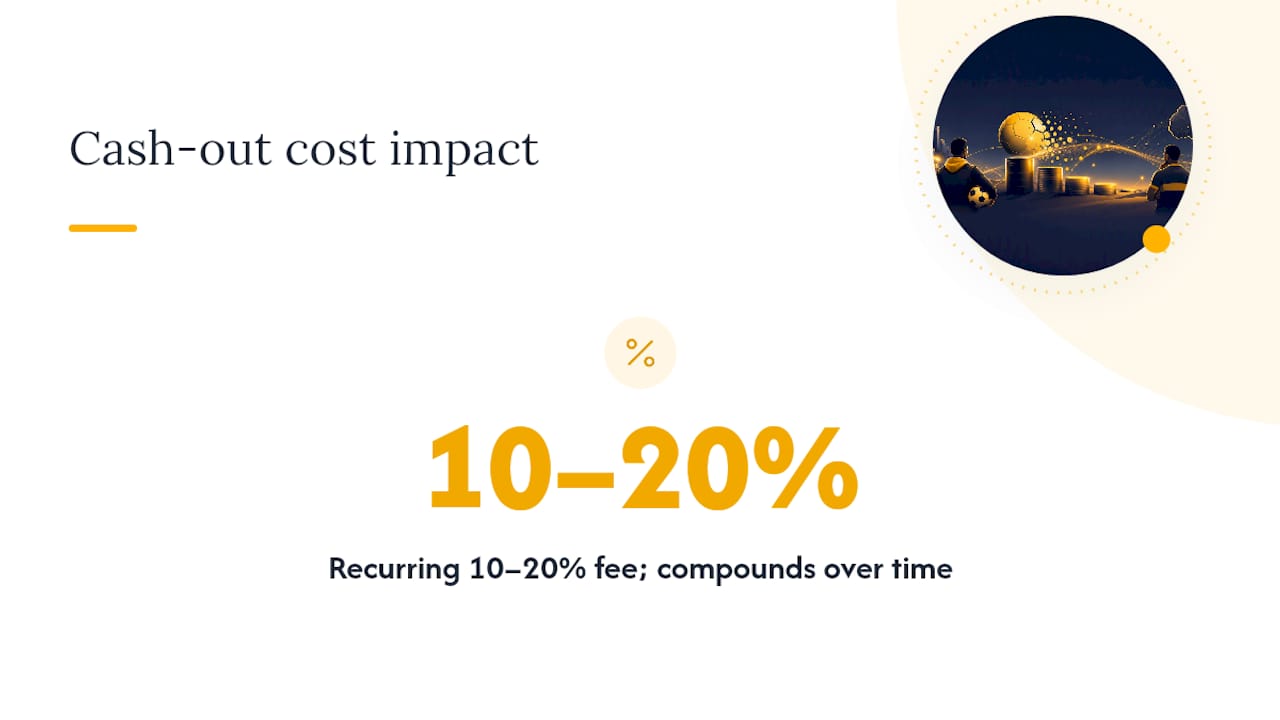
Bookmaker margins on cash-out offers commonly sit in the mid-teens, with some estimates ranging from roughly 10% to 20%, according to GotTheOdds. That’s not a one-time hit. It’s a tax you pay every single time you use the feature, and it compounds across a betting career the same way a small recurring fee eats into savings.
Set a personal threshold, whether that’s a dollar amount, a percentage of your stake, or a strict “emergencies only” rule, and stick to it. Use partial cash out sparingly rather than as a reflex on every accumulator. For a deeper framework on protecting your funds over time, Bet-mzansi’s bankroll management guide and its breakdown of accumulator betting are worth reading before your next multi-leg slip.
A Simple Rule for Using Cash Out Wisely
The rule I’d give any bettor is this: use cash out only when something has genuinely changed, an injury, a red card, a market you clearly misjudged, never as a way to soothe nerves during a close match. Pair that discipline with real bankroll limits, and the feature stops being a leak and starts being a tool.
— Nkosi
Learn More Before Your Next Bet
There are faster ways to understand cash-out terms across licensed South African bookmakers than digging through app menus one operator at a time. Resources that break down the fine print, including promo exceptions that can quietly cancel your cash-out eligibility, help you know the rules before you’re mid-match and pressed for time.
Start with the betting glossary if terms like vig or overround still feel fuzzy, then check the bankroll management guide to build limits that keep cash out working for you instead of against you. When you’re ready to compare operators directly, our best betting sites guide shows which platforms offer clearer cash-out terms and fairer promo conditions.
Where to Get Official Help and Support
- Bet365 Cash Out FAQs: official mechanics and availability rules.
- BeGambleAware: tools and support for safer betting habits.
- Gambling Therapy: practical help if betting behavior feels out of control.
Sources
- What is Cash Out in Betting? | GotTheOdds
- Cash out betting explained | OddsShopper
- Cash Out FAQs | bet365 Help
- BeGambleAware
- Gambling Therapy