When Ties Halve or Third Your Payout: Dead Heat Rules in South Africa
Calculate dead heat payouts with the stake division formula and worked two and three way examples for South African bookmakers.

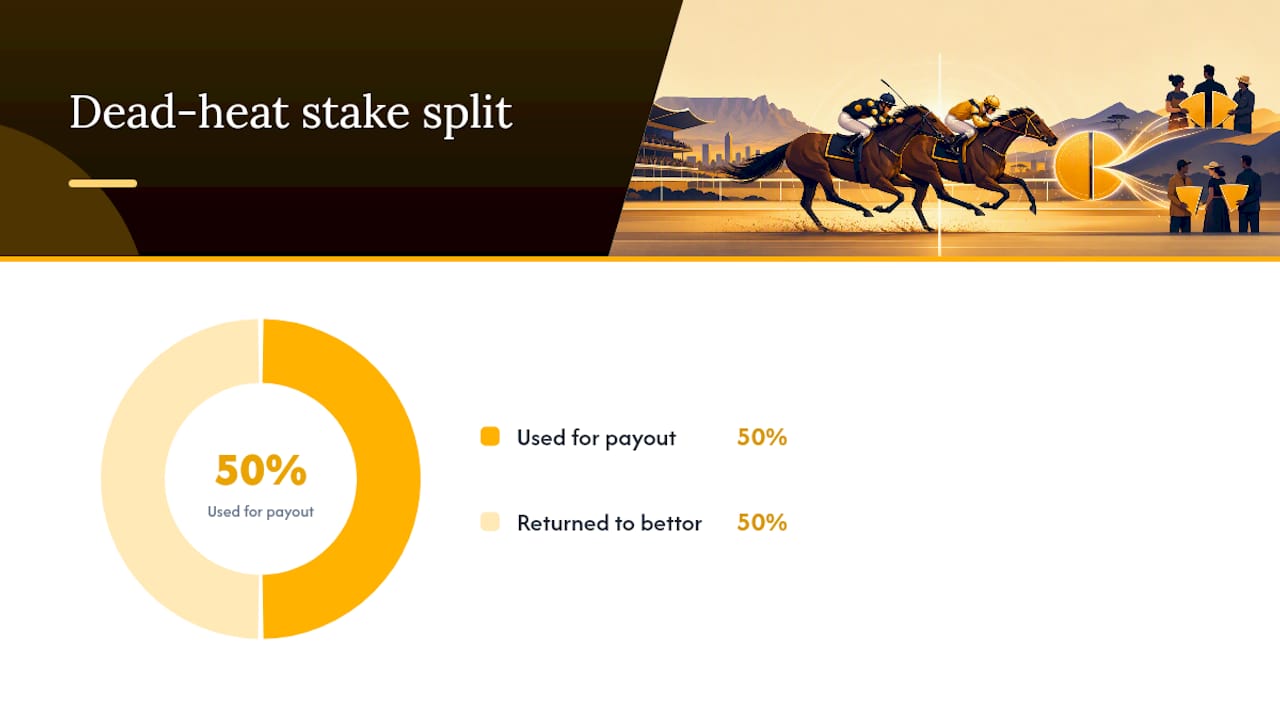
A dead heat splits your stake by the number of tied competitors and pays that reduced amount at your original odds. If two runners tie for first, you get half your stake back at full odds; three-way ties pay a third. This applies whether you bet win, each-way, or buried a finishing-position leg inside a parlay.
TL;DR:
- Dead heats split your stake by the number of tied competitors, reducing your payout proportionally at the original odds and returning the unused stake.
- In a two-way dead heat at 4.00 odds with a $50 stake, the payout drops from $200 to $125, with your original stake partially refunded.
- Dead heats are common in horse racing and golf, where photo finishes and tied scores frequently trigger settlement under these rules.
- Always verify the specific house rules and each-way terms before betting to understand how dead heats will impact your potential winnings.
- Incorporating dead-heat probabilities into your expected value calculations helps protect your bankroll from unexpected reductions.
Table of Contents
- What Are Dead Heat Rules and How Do They Work?
- Worked Examples: 2-Way and 3-Way Dead Heat Payouts
- Which Sports and Markets See Dead Heats Most Often
- How to Protect Your Bankroll From Dead-Heat Surprises
- Why Bet-mzansi Is a Reliable Source on Settlement Rules
- Treat Dead Heat Exposure as a Number, Not a Bad Beat
- Check House Rules Before You Bet, Not After
- Sources
- FAQ
What Are Dead Heat Rules and How Do They Work?
A dead heat happens when two or more competitors finish an event in a genuine tie that neither the judges nor the market anticipated as a distinct outcome. Racing stewards, golf scorers, or event officials make the call, not the sportsbook, and once it’s declared, the sportsbook applies a standard settlement formula rather than voiding the bet.
The math is simple:
- Adjusted stake = original stake ÷ number of tied competitors
- Payout = adjusted stake × original odds
- The unused portion of your stake is returned as if it were never wagered on the losing “half” of the tie
Bet $20 at 5.00 odds on a horse that dead-heats for first with one other runner. Your effective stake becomes $10. That returns $50 (the $10 stake × 5.00), plus you get your other $10 stake back. Total return: $60, not the $100 you’d have banked on an outright win.
Edge cases get messier when a tie spans multiple payout slots, which is where each-way betting comes in. Every major book, including Betfair, runs this same core formula for backers and layers alike, but the exact wording in each sportsbook’s help center can vary slightly on rounding and each-way place terms. Always check the specific house rules before you assume your ticket settles the way you expect.
Worked Examples: 2-Way and 3-Way Dead Heat Payouts
Here’s how the standard stake-division formula plays out across the ticket types you’re most likely to hold.
Example A: 2-way tie, straight win bet. You stake $50 at odds of 4.00 on a golfer who ties for the tournament win with another player.
- Divide the stake: $50 ÷ 2 = $25 adjusted stake
- Multiply by odds: $25 × 4.00 = $100 payout
- Add back the unused $25 of your original stake
- Total return: $125, versus $200 had your golfer won outright
Example B: 3-way tie for a place, each-way bet. Four horses are tied for 3rd through 6th in a race that only pays down to 4th place. Two of those four tied positions fall inside the payout cutoff. The reduction fraction here isn’t a flat one-third split; it’s (paying places covered) ÷ (competitors tied), so 2 ÷ 4 = 0.5. On a $20 place stake at 3.00 odds, your adjusted stake is $10, paying $30.
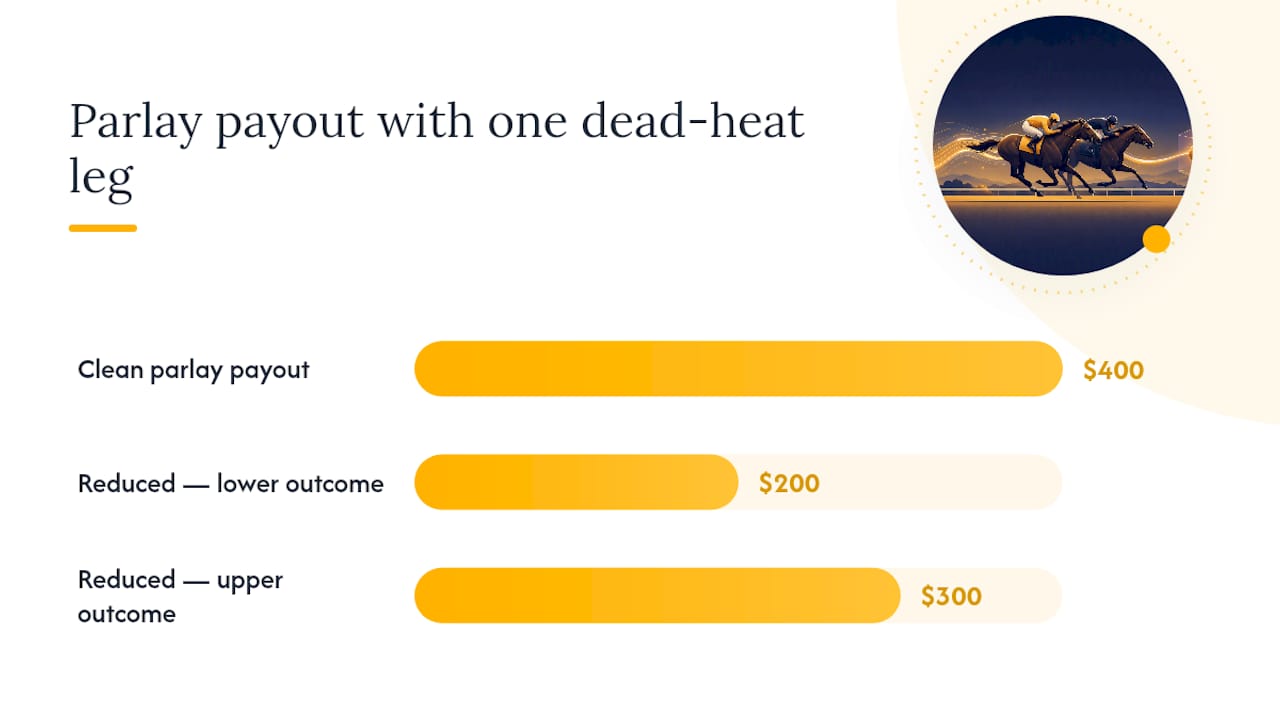
Example C: Parlay with one dead-heat leg. A three-leg parlay includes one finishing-position prop that dead-heats two ways. That leg’s effective stake gets halved before the parlay math runs through the remaining legs, which reduces the total payout rather than voiding the whole ticket. If your parlay had paid $400 on a clean sweep, expect something closer to $200 to $300 depending on how the other legs’ odds compound.
Pro Tip: Run the numbers before you place a finishing-position parlay leg. A quick stake-division check on your calculator tells you whether the potential dead-heat haircut still makes the bet worth the risk.
Which Sports and Markets See Dead Heats Most Often
Horse racing and golf are the two contexts where you’ll hit dead heat rules most often, largely because both sports produce frequent photo finishes and tied scorecards at the top of leaderboards. Finishing-position props, top-scorer markets, and statistical bets (most wickets, most assists) can trigger the same reduction when two entrants land on identical numbers.
- Horse racing: dead heats occur when the judge can’t split runners at the wire, even with photo-finish technology
- Golf: playoff-eligible ties on outright winner or top-finisher markets settle under dead heat rules if a book doesn’t offer a playoff-specific market
- Markets built around a tie outcome, like soccer’s draw option, are excluded entirely, since a draw there is a defined result, not an unresolved tie
- Timing-precision sports like swimming and track athletics rely on official electronic timing to a hundredth of a second, so true dead heats are rare, but they still happen and settle the same way when they do
How to Protect Your Bankroll From Dead-Heat Surprises
Read the house rules and place-term table before you place any finishing-position bet, especially each-way tickets where the payout cutoff matters more than the tie itself. Sportsbooks publish this information, but they don’t always surface it where you’d naturally look, so search their help center directly.
- Confirm how many places pay on your each-way market before assuming a standard fraction applies
- Check whether the book offers a dedicated tie or draw market as an alternative to a finishing-position bet
- Run the stake-division formula against your intended stake before submitting the bet, not after
- Avoid stacking finishing-position props into parlays unless you’ve already accepted the reduced-payout scenario
- Size your stake with the worst-case dead-heat outcome in mind, not just the clean-win outcome
Pro Tip: When you’re genuinely unsure how a field will finish, place a small separate hedge on the adjacent finishing position instead of loading your entire stake onto one spot. It costs you a little on the clean win but protects you from a full dead-heat haircut.
Reviewing how accumulators and parlays compound leg by leg also helps you spot exactly where a dead heat leg will bite hardest.
Why Bet-mzansi Is a Reliable Source on Settlement Rules
This guide is based on reviewing house rules and settlement examples from licensed South African bookmakers, rather than repeating marketing copy. This piece was put together by Nkosi. The content is prepared by a contributor who translates bookmaker rulebooks into calculations bettors can verify themselves.
- Definitions and payout math cross-checked against the Betting Glossary
- Odds mechanics covered in more depth in How Betting Odds Work
- Sport-specific dead heat context drawn from horse racing, where the rule shows up most often
Treat Dead Heat Exposure as a Number, Not a Bad Beat
Dead heat reductions aren’t random bad luck. They’re a fixed, predictable formula, and a bettor who models expected value on finishing-position markets should build in a conservative dead-heat discount the same way they’d account for via. My own habit, and the one I’d push any serious bettor toward, is to price every leaderboard-style bet as if a tie is slightly more likely than the odds imply. It costs you nothing when it doesn’t happen and saves you from an unpleasant surprise when it does.
— Nkosi
Check House Rules Before You Bet, Not After
It is important to check a bookmaker’s specific each-way and dead-heat wording before betting, as rules can differ between operators. Guides that provide plain-language definitions and math explanations can be useful as an alternative to navigating sportsbooks’ help articles.

The Betting Glossary breaks down dead heat, each-way, and place terms in plain language, and the broader Learn hub walks through odds conversion and settlement logic step by step. If you’re deciding where to place a finishing-position bet in the first place, our bookmaker reviews compare house rules side by side so you know exactly how a tie will settle before you fund the ticket. Start with the glossary, run your numbers, then place your bet with the outcome already mapped out.
Sources
Sportsbook help centers remain the definitive source for exact wording: Betfair’s dead heat rules, bet365’s dead heat FAQ, and DraftKings’ dead heat reduction guide all provide worked examples.
FAQ
How Do Dead Heat Rules Work?
A dead heat splits your stake by the number of tied competitors, then pays that reduced stake at your original odds while returning the unused portion of your money. The standard formula is the same across most licensed sportsbooks, though each-way place terms can shift the exact fraction.
Do Both Horses Win in a Dead Heat?
Yes, both horses are officially recorded as joint winners, but neither bettor gets a full winning payout. Each backer’s stake gets divided by the number of tied horses and settled at the original odds on that reduced amount.
What Happens to a Parlay If One Leg Dead-Heats?
The parlay isn’t voided. The dead-heating leg’s effective stake gets reduced before it feeds into the rest of the parlay calculation, which lowers the total payout but still pays out on the remaining legs.
Does the Dead Heat Rule Apply to Each-Way Bets?
Yes, and it’s where the math gets trickiest, since the reduction depends on how many of the tied positions actually fall within the payout cutoff. Sportsbooks like bet365 publish specific each-way examples because a straight one-third or one-half split doesn’t always apply when a tie straddles the place line.
Where Can I Check a Specific Bookmaker’s Dead Heat Rules?
Every licensed sportsbook publishes its dead heat and each-way terms in its help center or terms and conditions page, and the exact wording varies slightly between operators. Bet-mzansi’s bookmaker reviews compare these house-rule differences so you can check them before placing a bet.