Clear Your FICA Betting Account in 48 Hours on SA Sites
Clear FICA for your betting account in South Africa: exact documents, upload steps, PCC20 rules and Bet-mzansi links to speed verification.

Yes, FICA applies to your online betting account, and no bookmaker licensed in South Africa can let you place a bet with real money until your identity is verified. The moment you register, you’re entering a business relationship regulated under the FIC Act. Expect to submit an ID and proof of address early, and expect some restrictions on deposits or withdrawals until a licensed bookmaker clears your documents, usually within 48 hours.
TL;DR:
- Most South African bookmakers require documents like a government-issued ID and proof of address before allowing full betting and withdrawal activity.
- Automated checks usually verify documents within minutes, but delays occur if documents are outdated, blurry, or mismatch names, requiring resubmission.
- Foreign nationals must submit a passport and may face longer manual reviews due to cross-border verification complexities, especially if local banking details are absent.
- It is a legal requirement for bookmakers to reject deposits or betting until verification is complete, meaning delays are often law-driven rather than platform reluctance.
- Safeguarding your data involves choosing licensed operators bound by the FIC Act and POPIA, with most storing data securely and only using it for compliance purposes.
Table of Contents
- What FICA Compliance Means for Your Betting Account
- The FICA Document Checklist Every Bettor Needs
- How to Upload FICA Documents and What Happens Next
- What Bookmakers Are Required to Do Under PCC20
- Fixing the Most Common FICA Verification Delays
- FICA Rules for South African Citizens vs. Foreign Nationals
- How Your FICA Data Is Protected on Betting Platforms
- What Happens If Your FICA Verification Fails
- Why We Break Down FICA Compliance for South African Bettors
- Get Verified Faster With Bet-mzansi’s Betting Guides
- Where to Verify These FICA Rules Yourself
- Sources
- FAQ
What FICA Compliance Means for Your Betting Account
FICA is shorthand bettors use for a set of obligations that actually come from the Financial Intelligence Center Act. Under section 21 of that act, bookmakers count as accountable institutions, the same legal category that covers banks. That means they’re legally required to identify and verify every client before doing business with them, not just as a formality but as a condition of holding their gambling license.
Because most South African bookmakers operate online rather than face to face, the Financial Intelligence Centre issued specific guidance for this exact scenario. The Revised Public Compliance Communication No. 20, known in the industry as PCC20, spells out how bookmakers must verify non-face-to-face clients and confirms that treating your registration as the start of a business relationship isn’t optional.
Here’s what that means for you practically: signing up doesn’t automatically mean you can bet. Most platforms let you create a profile and browse markets, but they’ll cap or block real-money betting, and sometimes withdrawals, until your documents clear. If you’ve ever wondered why a new account suddenly won’t let you cash out a deposit bonus, this is almost always the reason. It isn’t the bookmaker being difficult. It’s the law.
The FICA Document Checklist Every Bettor Needs
Every licensed bookmaker in South Africa asks for roughly the same paperwork, because they’re all working from the same regulatory playbook. Getting these right the first time saves you days of back and forth with support.
- A government-issued photo ID, either your South African ID book, smart ID card, or passport, photographed in full with no cropped edges and no glare washing out the text.
- Proof of address dated within the last three months, such as a utility bill, bank statement, or municipal account, with your name and address clearly legible.
- A recent bank statement, especially if you plan to deposit by card or EFT, since bookmakers often need to match the account holder’s name to your registered details.
- A selfie holding your ID, which some platforms use for automated facial matching, so hold the document flat, use good lighting, and make sure both your face and the ID text are in focus.
The most common reason for a rejected upload isn’t fraud, it’s carelessness. A FICA upload guide from Casinos.org notes that South African platforms consistently reject documents over the three-month freshness limit, blurry phone photos, or scans where the name on the bank statement doesn’t match the name on the ID. Fix those three things before you upload anything, and you’ll likely skip a manual review entirely.
How to Upload FICA Documents and What Happens Next
Once you’ve got your documents ready, the actual submission process is fairly consistent across licensed operators. Here’s the typical flow:
- Log in and find your account settings. Look for a section usually labeled “My Documents,” “Verification,” or “FICA” inside your profile menu.
- Upload each document separately, matching file types to what the platform accepts (usually JPG, PNG, or PDF), and keep file sizes reasonable so uploads don’t time out.
- Wait for automated screening. Most systems run an instant check first, scanning for image quality, expiry dates, and basic name matching.
- Expect manual review if anything flags. A human compliance officer checks anything the automated system can’t confirm, which is where delays creep in.
- Watch for a notification. You’ll usually get an email, SMS, or in-app alert confirming verification, after which deposit and withdrawal limits typically lift.
Timelines vary, but they’re not random. Simple, clean submissions often clear within minutes through automated checks. Anything flagged for manual review commonly takes longer, and the Jabula Bets help center states verification can take up to two days on their platform, which is a fairly typical benchmark across the industry. If it’s been longer than that with no update, that’s your cue to check in with support rather than wait it out.
What Bookmakers Are Required to Do Under PCC20
The compliance burden isn’t just on you. Licensed bookmakers carry legal obligations of their own, and understanding them helps you spot a platform that’s cutting corners.
Bookmakers appear as accountable institutions under Schedule 1, item 9, of the FIC Act, which puts them in the same regulatory bracket as banks and other financial firms. PCC20 lays out acceptable ways for them to verify a client without meeting them in person, including confirming deposits come from a bank account bearing the customer’s own name, cross-checking details against credible third-party databases, or confirming an address through registered post.
The most important rule for bettors to know: PCC20 explicitly states it’s a contravention of the FIC Act for a bookmaker to accept funds for betting before your verification is complete. If a site lets you deposit and bet freely with zero document requests, that’s not a convenience, it’s a red flag. It’s also why a platform might come back asking for a second round of proof even after your initial upload, particularly if your first deposit comes from an account that doesn’t match your registered name.
Fixing the Most Common FICA Verification Delays
Most rejected documents fail for boring reasons, not sinister ones. A general guide to registering for online betting points out that mismatched names and outdated documents cause the majority of holdups, and both are entirely avoidable.
- Double check that your name appears identically on your ID, proof of address, and bank statement, no nicknames or shortened versions.
- Photograph documents flat, in daylight, without cropping any corner or edge.
- Confirm your proof of address is dated within three months before uploading it.
- If verification stalls past 48 hours, contact support through live chat or WhatsApp and attach clear copies rather than waiting for a follow-up email.
Pro Tip: Name your files something obvious, like “ID_Front_Yourname.jpg,” before uploading. Compliance teams process hundreds of submissions a day, and a clearly labeled file is less likely to get filed under the wrong review queue.
If deposits keep bouncing, ask your bank to confirm the account is registered under your full legal name. A named-account transfer is one of the verification methods PCC20 actually recommends, so using it can speed things along rather than slow them down.
FICA Rules for South African Citizens vs. Foreign Nationals
South African citizens generally have the simplest path through FICA, since their ID, address documents, and bank accounts all sit inside one national system that bookmakers can verify quickly through third-party databases. A South African smart ID card or green barcoded ID book, paired with a local utility bill, typically clears without much friction.
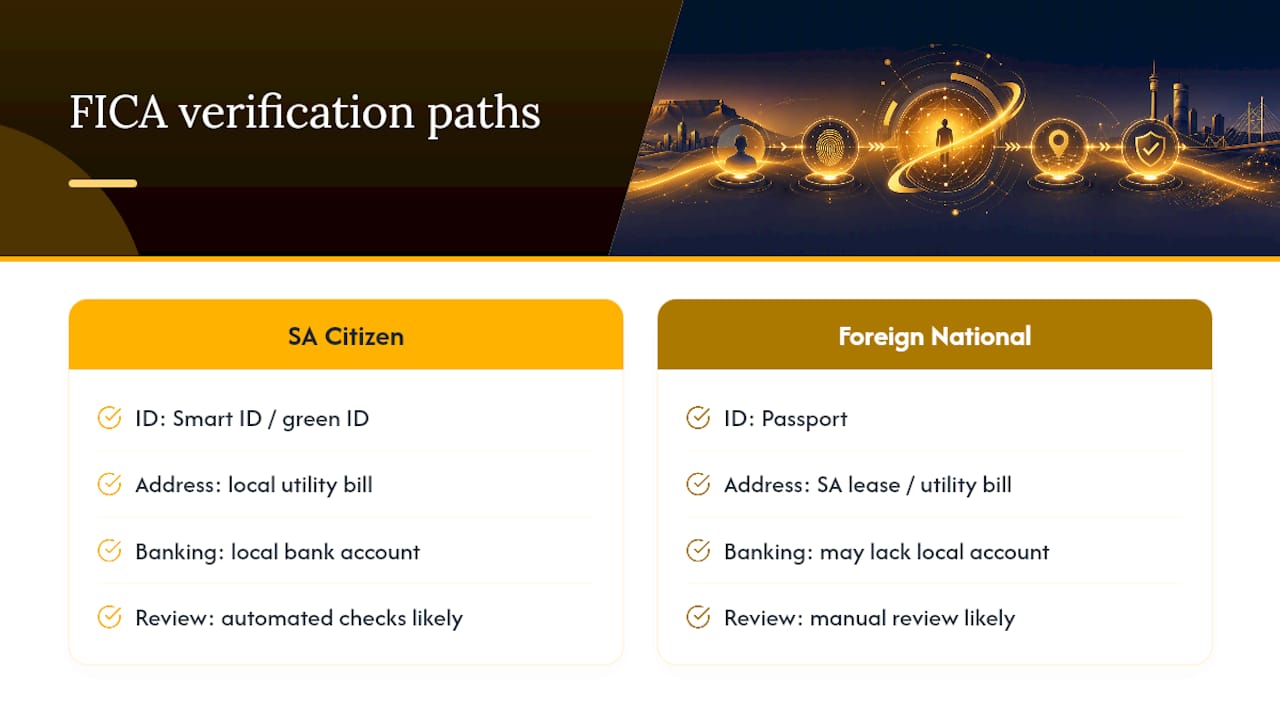
Foreign nationals face a slightly heavier lift, not because the law treats them unfairly, but because cross-border verification is inherently harder to automate. Instead of a South African ID, you’ll usually submit a passport, and proof of address may need to come from a South African source, such as a lease agreement or a utility bill in your name, if you’re a resident, rather than a document from your home country. Some platforms also ask foreign nationals for a valid visa or permit confirming their legal status in South Africa, particularly if local banking details aren’t yet in place.
The practical upshot: if you’re not a South African citizen, budget extra time for manual review. Automated database checks work best against local ID numbers, so a foreign passport almost always routes to a human compliance officer rather than an instant automated clearance. It’s not a bigger obstacle, just a slower one, and preparing a passport scan, a South African address document, and any relevant permit up front will keep that delay to a minimum.
How Your FICA Data Is Protected on Betting Platforms
Handing over your ID and bank details to a betting site understandably makes some bettors nervous, and that caution is fair. The documents you’re submitting aren’t casual uploads, they’re the same category of sensitive personal information banks collect, which is exactly why they’re regulated the same way.
Licensed South African bookmakers are bound by the Protection of Personal Information Act alongside their FIC Act obligations, meaning your ID copies, bank statements, and address proof can’t be used for anything beyond compliance and fraud prevention. They shouldn’t be shared with marketing partners, sold, or stored indefinitely without a lawful basis. Reputable platforms typically store this information on encrypted servers and restrict access to compliance staff rather than general customer support.

The practical takeaway for you: stick to bookmakers holding an actual South African gambling license, since that license is what ties them to both the FIC Act and POPIA enforcement. An unlicensed offshore site asking for the same documents carries no such accountability, and there’s no regulator you can complain to if your information gets mishandled. Before uploading anything, confirm the site’s license number is listed and verifiable, not just claimed in a footer.
What Happens If Your FICA Verification Fails
A failed verification isn’t the end of your betting account, but it does trigger real restrictions until it’s resolved. Most platforms respond to a failed check by suspending betting activity and freezing withdrawal access, while usually still allowing you to log in and view your account.
The most common outcome is a request for corrected or additional documents, not a permanent ban. If your ID photo was too dark or your proof of address had expired, the platform will typically flag exactly what failed and invite you to resubmit. Take that request seriously and respond with clean, current documents rather than reuploading the same file, which just repeats the same rejection.
In rarer cases, where details can’t be reconciled at all, such as a name mismatch that can’t be explained, some bookmakers may close the account and return any deposited funds rather than risk facilitating an unverifiable client. If you believe a rejection was made in error, most platforms offer an appeal path through their compliance or support team, where you can submit clarifying documents or explain a discrepancy directly. Keep records of every document you send and every response you get. If a dispute drags on, that paper trail is what you’ll need.
Why We Break Down FICA Compliance for South African Bettors
FICA confusion causes more abandoned sign-ups than almost any other part of the betting process, and that’s a shame, because none of it is actually complicated once someone walks you through it plainly. Bet-mzansi exists to close that gap. Confusing compliance language shouldn’t be the reason a bettor gives up on a legitimate, licensed platform.
Bet-mzansi builds detailed bookmaker reviews, a plain-language betting glossary, and sign-up guidance specifically so South African bettors can pick a properly licensed site and walk into registration already knowing what documents they’ll need. The goal isn’t just explaining the rules, it’s making sure you’re never caught off guard by them.
— Nkosi
Get Verified Faster With Bet-mzansi’s Betting Guides
Choosing between dozens of betting platforms and figuring out each one’s document rules on your own eats up time you’d rather spend actually betting. This site compiles information on licensed bookmakers, their bonus terms, and verification processes in one place to help users identify which operators manage FICA compliance efficiently.

Start by browsing Best Betting Sites in South Africa to compare licensed operators before you register anywhere. If you want to understand how those rankings get built, How We Review Betting Sites breaks down the criteria. And if a welcome bonus is part of your decision, having your ID and proof of address ready before you sign up means you can clear verification and start using that bonus without the usual wait. Pick a licensed site from our comparison page today and have your documents prepared before you hit register.
Where to Verify These FICA Rules Yourself
Read the regulator’s own guidance in PCC20, see real upload steps at Jabula Bets’ help center, or check Easybet’s FICA explainer for another platform’s example.
This article is general information, not a substitute for advice from a qualified lawyer. Consult a qualified legal professional about your own circumstances before acting on anything here.
Sources
- REVISED PUBLIC COMPLIANCE COMMUNICATION No. 20 (PCC20) CLIENT IDENTIFICATION AND VERIFICATION REQUIREMENTS FOR NON FACE-TO-FACE ONLINE BETTING CLIENTS
- Jabula Bets Help Center | How to submit your FICA
FAQ
Does FICA Apply to All South African Betting Sites?
Yes, any bookmaker licensed in South Africa is legally classed as an accountable institution under the FIC Act and must verify your identity before allowing betting activity.
Can I Deposit Money Before My FICA Is Approved?
Bookmakers may let you deposit, but PCC20 makes it a contravention of the FIC Act to let you use those funds for betting before verification is complete.
What Documents Do I Need for a FICA Betting Account?
Most platforms require a government-issued photo ID, proof of address dated within three months, and often a bank statement or selfie with ID.
Do Foreign Nationals Need Different FICA Documents?
Foreign nationals usually submit a passport instead of a South African ID and may need a local address document or visa, and their verification more often requires manual review.
What Happens if My FICA Documents Get Rejected?
Your account typically gets a betting or withdrawal restriction along with a request for corrected documents, and most platforms allow you to appeal or resubmit through support.