20% Operator Tax, Not Your Winnings: Gambling in South Africa 2026
Clear 2026 guidance for South African bettors: why the proposed 20% operator GGR tax targets bookmakers, when winnings are taxable, and how to comply.

For most South African players, gambling winnings are not taxed. Systematic, professional gambling, on the other hand, counts as income and gets taxed at standard individual rates. Separately, National Treasury has proposed a 20% tax on operators’ gross gambling revenue, which targets betting companies, not your payout. Watch the South African Revenue Service (SARS) and National Treasury for how this settles.
TL;DR:
- Most recreational South African bettors will not be directly taxed on their winnings, as casual gambling is treated as a windfall, not income.
- The proposed 20% tax targets operators’ gross gambling revenue, which is the amount retained after payouts, not total bets or winnings.
- Professional gamblers earning income from systematic, high-volume betting will owe taxes at personal rates and must keep detailed records to declare net profits.
- No withholding tax currently exists on individual winnings; provincial levies are applied on operator revenue, not deducted directly from player payouts.
- Operator costs, including the new tax, are likely to be passed to bettors through narrower bonuses, wider odds margins, or reduced promotional offers.
Table of Contents
- What the Proposed 20% Operator Tax Actually Means
- Are My Winnings Taxable? Recreational vs Professional Gamblers
- Was There Ever a Withholding Tax on Winnings?
- VAT and Provincial Taxes: Why Operator Accounting Looks Nothing Like Yours
- Filing as a Professional Gambler: Steps That Keep You Compliant
- What an Operator Tax Squeeze Means for Your Betting Experience
- Casual vs Professional: Why the Label Matters More Than the Amount
- How to Report Gambling Winnings on Your Tax Return
- Can You Deduct Gambling Losses Against Winnings?
- What If Your Winnings Come From a Foreign Operator?
- Bet Mzansi’s Take: Watch the Policy, Not the Panic
- Where to Go Next for Practical Betting Guidance
- Sources
- FAQ
What the Proposed 20% Operator Tax Actually Means
Gross gambling revenue (GGR) is simple math: total bets received minus total payouts to players. It’s the actual money an operator keeps, not the volume of cash moving through betting slips. National Treasury’s proposal would apply a 20% charge to that retained amount, and it sits squarely on the operator’s side of the ledger.
Here’s what that looks like with an example. If an online bookmaker receives a large amount in bets over a month and pays out most of it as winnings, its gross gaming revenue is the amount it retains after payouts. Under the proposed structure, the operator would owe 20% of that retained amount, not 20% of everything wagered.
A few things worth knowing about where this stands:
- The proposal has gone through extended public consultation, and the final rate or design could still shift before implementation.
- It would sit alongside existing provincial gambling taxes, not replace them.
- Nothing in the current draft touches individual player payouts directly.
Are My Winnings Taxable? Recreational vs Professional Gamblers
SARS doesn’t tax a windfall. If you back the right numbers, win a casino jackpot, or land a lucky bet on a Saturday soccer fixture, that money is generally treated as a non-taxable gain, according to PATC’s tax guidance. The line shifts once gambling stops being a hobby and starts looking like how you make a living.
Tax practitioners point to a specific test, and it comes down to whether your activity amounts to a “trade.” SARS and tax advisers generally weigh:
- Frequency. Do you bet occasionally, or is it a near-daily activity with volume behind it?
- Organization. Do you track results, run a bankroll, follow a system, or keep spreadsheets?
- Intent to profit. Are you playing for entertainment, or explicitly running it as an income source?
- Reliance on the income. Does gambling replace or supplement a salary?
A quick contrast: a nurse who places a weekly lucky numbers ticket and wins R50,000 keeps every rand tax free. A former bookmaker’s trader who quit his job to trade sports markets full time, using staking models and daily volume, is running a trade. SARS would expect that second person to declare net profit.
Professional gamblers are taxed at standard individual tax rates, which climb as high as 45% for 2026 income above R1,817,000. Losses matter here too. Section 20A ring-fencing means gambling losses can only offset gambling income, not your other earnings, so a bad month at the tables won’t shrink the tax bill on a day job.
Was There Ever a Withholding Tax on Winnings?
You may have heard whispers about a 15% tax deducted straight from payouts. That idea surfaced around 2011 and 2012 as a proposed withholding on player winnings, but it never became law. No general withholding tax applies to what lands in your betting account today.
What does exist instead:
- Provincial levies charged to operators, baked into how licensed bookmakers and casinos account for their revenue.
- No line-item deduction from your winnings before they reach your wallet or bank account.
- Rare exceptions in specific regulated payout scenarios where an operator’s compliance process flags a transaction, though this isn’t a player-facing withholding tax.
VAT and Provincial Taxes: Why Operator Accounting Looks Nothing Like Yours
SARS regulations effective January 1, 2025, clarified how casinos account for VAT on table games of chance. Operators calculate VAT using the gross gaming revenue method, meaning VAT is worked out on what the casino actually retains after paying winners, and they must keep detailed records supporting every VAT return filed. The accompanying explanatory memorandum spells out exactly how that GGR figure should be derived and reported.
On top of VAT, provinces run their own gambling tax structures:
- Bookmakers typically face provincial rates in the range of 6% to 9% of GGR.
- Casinos generally sit higher, often between 10% and 15% of GGR.
- Exact rates vary by province, since each provincial licensing board sets its own schedule.
None of this touches individual returns. Operator tax filings run through corporate accounting systems built around GGR, VAT invoicing, and provincial reporting cycles. Your tax return, by contrast, only cares about whether your gambling activity qualifies as a trade.
Filing as a Professional Gambler: Steps That Keep You Compliant
If your gambling looks like a business to SARS, treat your compliance the same way any small business owner would.
- Keep contemporaneous records. Save betting slips, platform transaction logs, bank statements, and any staking or strategy notes as you go, not months later when SARS asks.
- Declare net profit, not gross winnings. You’re taxed on what’s left after losses within the same activity, not on every winning bet in isolation.
- Register for provisional tax if income is significant or irregular. This applies when gambling profit forms a meaningful, recurring share of your income.
- Respect the ring-fencing rule. Section 20A caps how gambling losses offset other income streams; they stay contained to gambling profit.
- Correct mistakes through the Voluntary Disclosure Programme. Tax practitioners note that understatement penalties and interest can be steep, and the VDP route is far cheaper than getting caught first.
Pro Tip: Open a separate account just for gambling activity. It turns your bank statement into a ready-made audit trail and saves hours if SARS ever asks for proof of net profit.
What an Operator Tax Squeeze Means for Your Betting Experience
A 20% charge on GGR doesn’t vanish into thin air. Operators typically absorb new costs by adjusting the parts of the business they control directly, and industry analysts expect margin and promotional budgets to be the first levers pulled.
Practically, that could show up as:
- Smaller welcome bonuses or fewer free bet promotions across the board.
- Odds priced with slightly wider margins built in, shaving a fraction off your expected long-run return.
- Loyalty programs and cashback offers trimmed rather than expanded.
Picture a bookmaker currently offering odds that imply a 5% margin. You’d never see a tax line item on your bet slip, but your long-term payout percentage would quietly shrink. Understanding how betting odds work helps you spot when margins widen.
Casual vs Professional: Why the Label Matters More Than the Amount
There’s no rand-value threshold that flips you from recreational to professional. A single R2 million lottery win doesn’t make you a professional gambler; a modest but relentless R500-a-day sports betting operation might. SARS and tax advisers look at behavior and structure, not the size of any one payout.
This trips people up constantly. A player assumes a huge win must trigger tax simply because of its size, while another assumes small, frequent bets are automatically safe. Neither assumption holds. What matters is whether the activity, taken as a whole, resembles a business: repeated action, a system behind it, and reliance on the proceeds.
Consider two examples side by side. A teacher who plays lucky numbers a few times a month and occasionally wins a few thousand rand stays firmly in windfall territory, tax free every time. A person who left formal employment to bet full time, tracking form, staking bankroll percentages, and living off the proceeds, has crossed into taxable trade territory regardless of whether any single win looks modest.
The SARS test hinges on evidence of a trade, not a specific number. That means two people with identical winnings in a given year could face completely different tax outcomes depending on how they got there.
How to Report Gambling Winnings on Your Tax Return
Recreational winnings generally don’t appear on your return at all. If SARS treats a payout as a non-taxable windfall, there’s no line item, no schedule, and no disclosure requirement tied to that specific win. Most South African bettors placing casual wagers on soccer, rugby, or lucky numbers never touch this section of their tax return.
Professional or trade-classified gambling income works differently. It gets declared as trading income on your annual return, reported as net profit after deducting related losses within that same gambling activity. This isn’t a separate “gambling income” category on the SARS eFiling form. It slots into the same trading or business income section used by any other self-employed taxpayer.
Practically, that means:
- You report the net figure, calculated from your own records, not the gross total of every winning wager.
- Supporting documentation, bank statements, platform logs, staking records, needs to back up that number if SARS queries it.
- If gambling is your sole or primary income source, provisional tax registration becomes relevant, since income arrives irregularly rather than through a fixed monthly salary with PAYE already deducted.
One nuance catches people off guard: there’s no dedicated “gambling” checkbox on the standard SARS return. If you’re filing as a professional gambler, the income sits under trade or business income, the same section a freelancer or small trader would use. That’s another reason the recreational versus professional distinction covered earlier matters so much before you even open your eFiling profile.
Can You Deduct Gambling Losses Against Winnings?
Only within the same activity, and only if you qualify as trading. Recreational players can’t deduct losing bets against anything, because their winnings were never taxable income to begin with. There’s nothing to offset when the underlying win was already tax free.
For players classified as running a gambling trade, losses do count, but strictly within Section 20A’s ring-fencing rules. Your gambling losses offset your gambling profits within that same tax year and that same activity. They can’t be used to reduce tax owed on a salary, rental income, or investment returns from an unrelated part of your finances.
Here’s a concrete way to see it. A professional sports bettor wins R400,000 across various bets during the year but also loses R150,000 on other wagers within that same trading activity. Net taxable gambling profit comes to R250,000, and that’s the figure declared, not the full R400,000 in gross wins. If that same person also earns a R300,000 salary from unrelated freelance consulting, none of the R150,000 in gambling losses can chip away at tax owed on that consulting income.
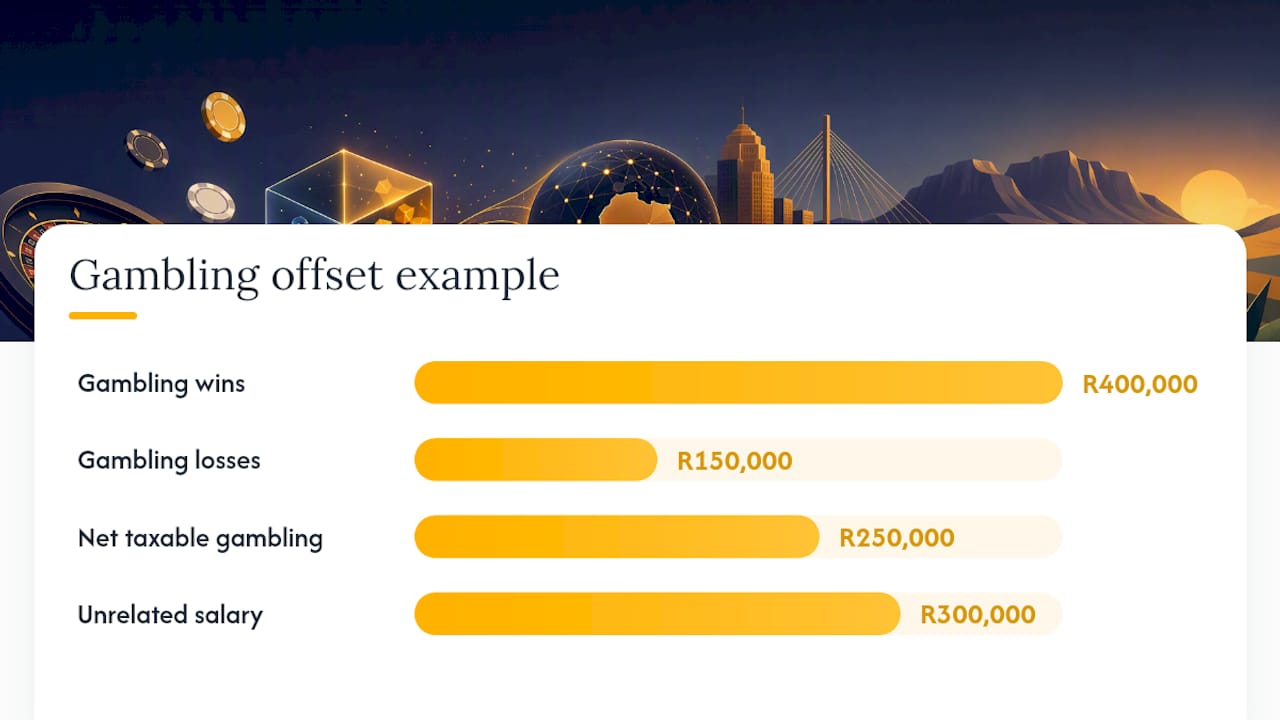
This ring-fencing exists specifically to stop taxpayers from using a losing side hustle to shelter unrelated earnings. It’s a rule tax advisers flag constantly, because the instinct to “net everything together” at filing time is common and expensive when SARS catches it during an audit.
What If Your Winnings Come From a Foreign Operator?
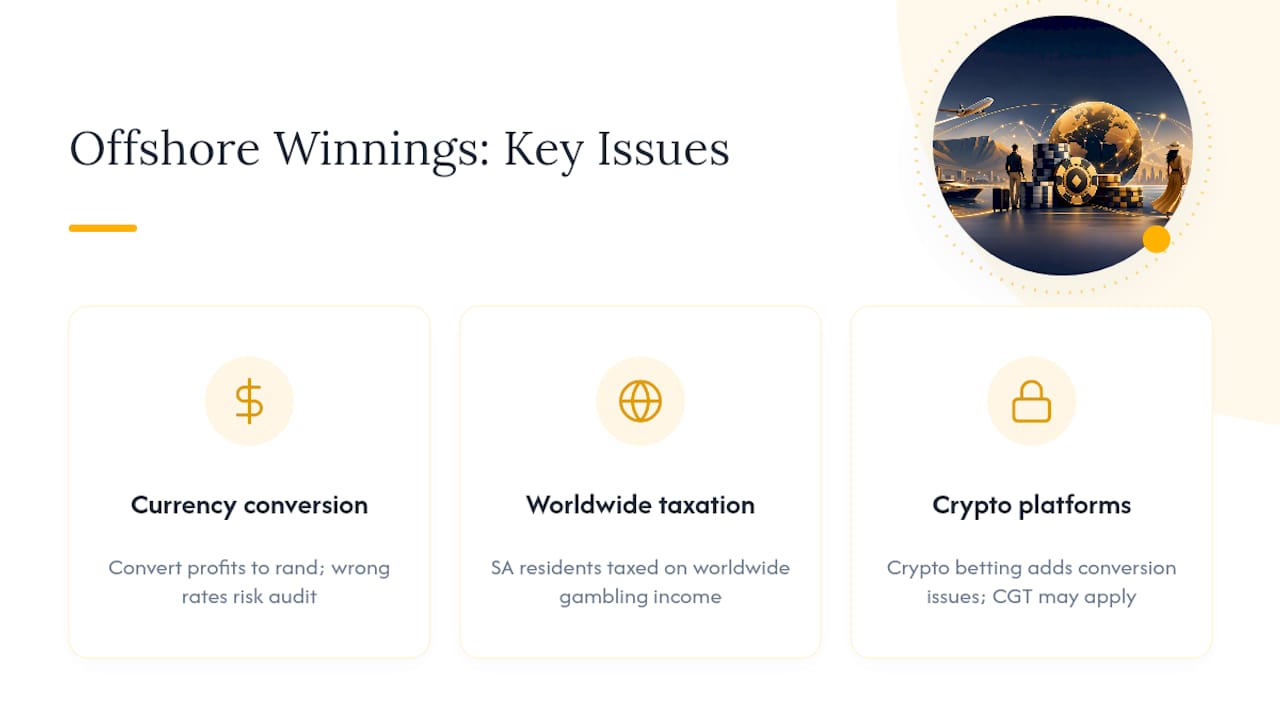
Offshore platforms, international poker sites, or overseas sportsbooks add a layer most South African bettors haven’t considered. The recreational versus professional test still applies first: a casual win from a foreign site follows the same windfall logic as a local one, generally untaxed if you’re not running gambling as a trade.
Complications show up in two places. First, currency conversion matters for anyone required to declare gambling as trading income; profits need converting to rand at the applicable exchange rate for that tax period, and inconsistent conversion methods are a common audit trigger. Second, South African tax residents are taxed on worldwide income once gambling qualifies as a trade, meaning a professional gambler using offshore platforms doesn’t escape SARS obligations simply because the operator is based outside the country.
Crypto-denominated platforms add another wrinkle worth flagging. Betting through a crypto casino introduces both currency conversion questions and, for anyone trading gambling as a business, potential capital gains considerations on crypto holdings themselves, separate from the gambling profit calculation. That’s a genuinely specialized area, and it’s one where generic advice runs out fast; a tax practitioner familiar with both gambling classification and crypto tax treatment is worth the consultation fee if this applies to you.
Bet Mzansi’s Take: Watch the Policy, Not the Panic
The operator tax conversation gets louder than it needs to. Most recreational bettors owe nothing and never will under this proposal; it targets operator revenue, not your winnings. Our advice: track SARS and Treasury updates, keep basic records if you bet often, and talk to a tax professional the moment gambling starts feeling like income rather than entertainment. Our glossary and betting guides break down the terms this debate keeps throwing around.
— Nkosi
Where to Go Next for Practical Betting Guidance
Understanding the tax side is one thing. Staying ahead of how operators actually respond, tighter bonuses, adjusted odds, new promotional terms, is another, and that’s where Bet-mzansi does its real work. We track licensed South African bookmakers side by side so you can see exactly where welcome offers and odds structures stand right now, before any operator tax changes ripple through.

If terms like GGR, gross win, or net drop came up in this piece and left you guessing, our betting glossary breaks each one down in plain language. Curious whether a specific bookmaker’s promotions have shifted recently? Our Learn hub walks through how odds and bonus structures actually work, so you can spot a tightened offer before you claim it. Start by checking the best betting sites in South Africa right now to compare current welcome bonuses and payout terms before operator-side tax changes take effect.
This article is general information, not a substitute for advice from a qualified financial advisor. Consult a qualified financial professional about your own circumstances before acting on anything here.
Sources
- Gambling in South Africa: Tax Implications You Need to Know - PATC
- South Africa extends consultation on proposed online gambling tax - FocusGN
- Regulations for casino table games of chance (SARS / Government Gazette)
- Gambling tax in South Africa — What SARS actually says | BetProof
FAQ
How much tax do I pay if I win the lottery in South Africa?
Lottery winnings are generally treated as a non-taxable windfall, so most players pay no tax on a lucky numbers or National Lottery payout unless gambling is run as a formal trade.
Do I pay tax on Lottoland or similar international lottery winnings?
The same recreational versus professional test applies regardless of whether the platform is based in South Africa or abroad; a casual win is generally untaxed, though currency conversion and residency rules can apply if you’re classified as a professional gambler.
Is money from playing casino games or sports betting taxable?
Casual winnings from casino games or sports betting are typically non-taxable windfalls, but if you bet frequently, systematically, and rely on it as income, SARS can classify it as taxable trade income.
How much does SARS actually expect to collect from the proposed 20% tax?
Specific revenue projections haven’t been finalized publicly since the proposal remains in consultation, and the final tax design could still change before implementation.
Will the proposed operator tax show up as a deduction on my winnings?
No.