Remote Gambling Act Explained: Why Bet365 Is Off-Limits for South African Bettors
Bet365 blocks South African sign ups and holds no local license. See how the Remote Gambling Act applies, how to verify a site's license, and safe local...
Bet365 does not accept new account registrations from residents of South Africa, and using it, or any other unlicensed offshore bookmaker, from inside the country falls outside South Africa’s remote-gambling framework. The Remote Gambling Act requires an operator to hold a license to serve South African players, and Bet365 holds none. The safer, lawful route is a bookmaker licensed by a South African provincial gambling board.
TL;DR:
- South African residents cannot register new Bet365 accounts, as the bookmaker explicitly blocks sign-ups from South Africa during the registration process.
- Using unlicensed offshore sites like Bet365 is illegal under South African law, which requires operators to hold a local license to serve bettors in the country.
- Transactions with unlicensed offshore sites are riskier because payments may be blocked, winnings can be forfeited, and dispute resolution is unavailable domestically.
- Verifying a site’s license through official provincial gambling board registers and checking for South African payment methods are essential before depositing funds.
- The safest legal betting options are only from locally licensed operators that provide enforceable withdrawals and oversight from South African regulators.
Table of Contents
- Can You Use Bet365 in South Africa Right Now?
- What Does South African Law Say About Remote Gambling?
- What Happens if You Bet on an Unlicensed Offshore Site?
- How Do You Check if a Betting Site Is Legal in South Africa?
- What Are the Legal Alternatives to Bet365 in South Africa?
- Why Bet-mzansi Recommends Licensed South African Bookmakers
- Find a Licensed Bookmaker That Actually Works for You
- Sources
Can You Use Bet365 in South Africa Right Now?
Try registering a new Bet365 account from a South African address and you’ll hit a wall before you even get to the deposit screen. Bet365’s own account registration help page states plainly that it does not accept customers from certain countries, and if your country of residence isn’t on the accepted list during sign-up, you simply cannot create an account. South Africa falls into that excluded category.
This isn’t a rumor or a temporary glitch. Independent industry reporting on legal betting options in South Africa consistently confirms that Bet365 does not accept South African players, pointing bettors instead toward operators that hold local licenses. That consistency across Bet365’s own guidance and third-party coverage rules out any ambiguity about current availability.
What does this look like in practice for someone trying anyway?
- The sign-up form either rejects South Africa as a country of residence or fails to load it as an option at all.
- Accounts created years ago under a different address may still function, but new registrations from South Africa are blocked.
- Some bettors attempt to work around this using VPNs or foreign addresses, which violates Bet365’s own terms of service and adds a separate layer of risk on top of the legal issues covered below.
Pro Tip: If a betting site’s registration page auto-detects your location and blocks you or shows no South African option, treat that as your answer. Don’t chase workarounds; look for a licensed local alternative instead.
What Does South African Law Say About Remote Gambling?
South Africa regulates online betting through two connected pieces of legislation: the National Gambling Act, which set up the country’s licensing structure, and the newer Remote Gambling Act, which specifically targets online and remote wagering. Together they establish that any operator offering remote gambling to a person located in South Africa needs a license, regardless of where that operator is physically based.
The Republic’s remote-gambling legislation provides for the licensing and regulation of remote gambling, makes unlicensed remote gambling unlawful, and sets standards for enforcement and player protection.
That’s the core of it. An offshore site doesn’t get a pass just because its servers sit in Malta or the Isle of Man. If it’s taking bets from someone sitting in Johannesburg or Durban without a South African license, that activity is unlawful under South African law.
Licensing authority is split between national and provincial levels. Legal commentary on South Africa’s gambling regime explains that licensing is structured so that provincial gambling boards, like the Gauteng Gambling Board, issue and oversee licenses for bookmakers operating within their provinces, while the National Gambling Board sets policy and coordinates enforcement nationally. A bookmaker legally serving South African bettors will typically hold a license from a specific provincial authority, not some vague offshore certificate.
The practical fallout for bettors centers on enforceability:
- Bets placed with an unlicensed remote operator are not protected under South African consumer or contract law in the same way a licensed transaction is.
- Winnings from unlicensed activity can be subject to forfeiture rather than being treated as a legitimate payout.
- Debts run up gambling on an unlicensed site may be unenforceable, which sounds like a loophole until you realize it cuts both ways: your winnings aren’t guaranteed either.
That last point matters more than most bettors realize. A win on an unlicensed platform isn’t a legal entitlement the way it is with a provincially licensed operator.
What Happens if You Bet on an Unlicensed Offshore Site?
Every time someone in South Africa places a bet on a foreign-based gambling site without a local license, that single transaction counts as unlawful gambling activity under current law. It’s not a gray area triggered only by large sums or repeated use. One bet is enough to fall outside the legal framework.
Here’s what that exposure actually looks like in practice:
- Banking friction. South African banks increasingly flag or block payments tied to offshore gambling sites, since payment flows through the banking system can facilitate unlawful gambling transactions, and regulators are watching that channel closely for money-laundering risk.
- Unenforceable winnings. As covered above, funds won through unlicensed remote gambling can be forfeited rather than paid out, with little recourse if the operator simply decides not to honor a withdrawal.
- No local dispute resolution. A licensed South African bookmaker answers to a provincial gambling board if something goes wrong. An offshore site answers to nobody in this jurisdiction.
- Fraud and account risk. Offshore sites operating outside local oversight carry a higher chance of account freezes, unexplained closures, or outright scams with no regulator to escalate to.
Bet-mzansi’s take: the banking angle is the one most bettors overlook entirely. It’s easy to assume the risk is abstract, something that only matters if you get caught in a legal sense. In reality, the more immediate consequence is far more mundane: your card gets declined, your transfer gets held, or your account gets flagged, and you’re left with no one to call.
How Do You Check if a Betting Site Is Legal in South Africa?
Before you deposit a single rand anywhere, run through a quick verification pass. It takes a few minutes and saves you from the exact problems described above.
Start with the footer of the site. A legitimate South African bookmaker will display a license number and the name of the issuing authority, usually a provincial gambling board, clearly on the homepage or in the terms and conditions. If that information is missing, vague, or references a jurisdiction with no connection to South Africa, that’s your red flag.
- Cross-check the license number against the National Gambling Board’s records or the relevant provincial board’s public register.
- Confirm the site explicitly lists South African payment methods (EFT, local debit cards, or SA-specific mobile payment options) rather than only crypto or international wire transfers.
- Look for a FICA verification step during account setup. Licensed operators are required to confirm your identity and address, and skipping this step entirely is unusual for a compliant site.
- If anything feels unclear, contact the National Gambling Board or the relevant provincial authority directly to confirm a license is active and covers online betting specifically.
Pro Tip: Bookmark the provincial gambling board’s license register for whichever province you’re checking. A five-minute lookup before you deposit beats weeks of frustration trying to recover funds later.
What Are the Legal Alternatives to Bet365 in South Africa?
Locally licensed bookmakers are the only route that gives you real legal footing, enforceable withdrawals, and a regulator to turn to if something goes sideways. That’s not a minor technicality. It’s the entire difference between a bet you can trust and one you’re gambling on twice over.
Getting started with a licensed operator follows a predictable pattern. You register with your ID number and address, complete FICA verification by submitting proof of identity and residence, then link a South African bank account or approved payment method for deposits and withdrawals. Bet-mzansi’s comparison hub for licensed South African bookmakers walks through this process for individual operators, including reviews like the Sunbet breakdown that show exactly what safety checks a licensed site should pass.
If you’re weighing alternative payment rails, it’s worth knowing that some newer platforms lean on crypto deposits through partners like Solana Casino or Cardano Casino. These come with their own volatility and verification considerations, and they don’t substitute for confirming a South African gambling license first.
A short safety checklist before you move any money:
- Screenshot or save your registration confirmation and any license details displayed on the site.
- Keep records of every deposit and withdrawal, including dates and reference numbers.
- Report suspected fraud or a stuck payout to the National Gambling Board or your provincial board immediately, and retain all correspondence.
| Step | Locally licensed operator | Unlicensed offshore site |
|---|---|---|
| Registration | Requires FICA (ID, address proof) | Often minimal or no verification |
| Payment methods | SA bank EFT, local cards | Frequently crypto or foreign cards only |
| Dispute resolution | Provincial gambling board oversight | No local regulator |
| Winnings enforceability | Legally protected | Subject to forfeiture risk |
Why Bet-mzansi Recommends Licensed South African Bookmakers
We built our review process around one question: would we trust this site with our own money? That means checking provincial license numbers against official registers, testing FICA and withdrawal flows firsthand, and rejecting operators that dodge basic transparency. You can read the full breakdown on our review methodology page.
Local licensing isn’t paperwork for its own sake. It’s what gives you a regulator to call when a withdrawal stalls or a bonus term seems unfair. Offshore sites like Bet365 offer none of that safety net to South African bettors, license or no license.
— Nkosi
Find a Licensed Bookmaker That Actually Works for You
Bet-mzansi exists precisely for the moment you just hit: Bet365 is off the table, and you need a real, working alternative that won’t leave your withdrawal stuck in limbo. Unlike chasing an offshore site with no local accountability, our Best Betting Sites in South Africa hub gives you side-by-side comparisons of provincially licensed operators, checked against the same registers covered earlier in this guide.
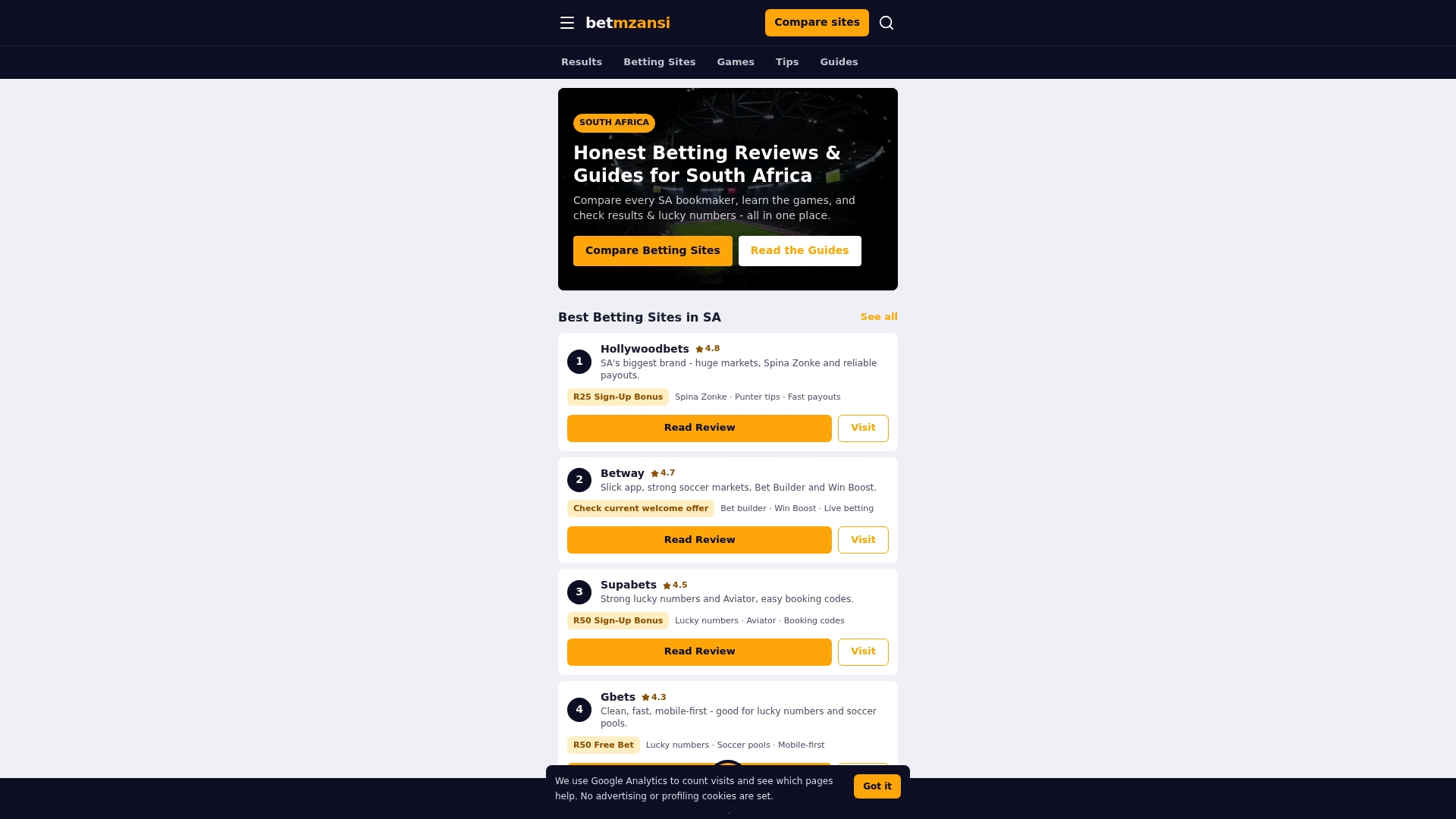
Every review we publish, including deep dives like our World Sports Betting breakdown, follows the verification steps outlined on our how-we-review page: license checks, payment testing, and honest reporting on what actually happens when you try to withdraw. If you’re new to South African betting terminology, our betting glossary is worth a look before you register. Head to Bet-mzansi and pick a licensed operator that will actually pay you when you win.
This article is general information, not a substitute for advice from a qualified lawyer. Consult a qualified legal professional about your own circumstances before acting on anything here.
Sources
- Remote Gambling Act — Republic of South Africa (government PDF)
- Open bet365 account FAQs — bet365 Help
- The facilitators, criminals and money-launderers in SA’s gambling crisis — Daily Maverick
- Gambling laws and regulations — South Africa (ICLG)