2026: Online Sports Betting Legal in South Africa, Check Licences
2026: South Africans may only place online sports and racing bets with provincially licensed operators. Use a 5 step licence check and avoid offshore sites.

Online sports and racing betting is legal in South Africa, but only through bookmakers licensed by a Provincial Gambling Board. Online casino-style gambling, meaning slots, roulette, or blackjack played over the internet, remains unlawful for anyone placing bets from within South Africa, regardless of where the site is hosted. The National Gambling Board and the nine provincial licensing authorities oversee this system. The rest of this guide shows you how to tell the difference in practice.
TL;DR:
- Only sports betting and horse racing wagers licensed by provincial authorities are legal for South African players; casino-style games remain prohibited regardless of location.
- Verify licences by checking provincial licence numbers, confirming with the relevant board, and ensuring FICA checks and local payment options are in place before depositing.
- Offshore gambling sites without visible licences or local banking options carry significant risks, as they fall outside the regulation and recourse mechanisms of South African authorities.
- The current legal framework does not permit online casino gaming, and legislation to regulate such products is still pending, with no expected quick changes before 2026.
- Report unlicensed gambling operators to provincial authorities, keep documentation, and use responsible gambling tools like self-exclusion and deposit limits to protect yourself.
Table of Contents
- Is Online Betting Legal in South Africa: What the Law Allows and Forbids
- Who Regulates Online Betting in South Africa
- How to Verify a Bookmaker’s Licence Before You Deposit
- The Real Risk of Offshore and Unlicensed Betting Sites
- Player Protections and Responsible Gambling Support
- Where the Remote Gambling Bill Stands Heading Into 2026
- What to Do If You Run Into Trouble With a Betting Site
- What Responsible Betting in South Africa Actually Looks Like
- Where Bet-mzansi Fits Into Your Betting Decisions
- Sources
Is Online Betting Legal in South Africa: What the Law Allows and Forbids
South African law draws a sharp line most bettors never hear explained. Online betting, meaning fixed-odds or totalisator wagers on sports, horse racing, and similar events, is legal when a Provincial Gambling Board licenses the operator. Interactive gambling, the industry term for casino-style games played through a browser or app, is a different category entirely, and it stays illegal for South African players under the National Gambling Act 7 of 2004.
The distinction matters because of where the bettor sits, not where the server sits. Courts have repeatedly confirmed this, including reasoning tied to the long-running Piggs Peak and Portapa cases, and recent legal analysis confirms that hosting a casino platform offshore, say in Curaçao or Malta, does nothing to legalize it for a player logging in from Durban or Polokwane. The player’s physical location at the time of the bet is what determines jurisdiction.
In practice, that leaves two lawful online categories:
- Sports betting through a provincially licensed bookmaker
- Horse racing and totalisator wagers through licensed operators
Anything styled as a virtual casino, live-dealer table, or slot reel falls outside that permission, no matter how polished the site looks or how many South African payment logos it displays.
Who Regulates Online Betting in South Africa
Two tiers of authority run the system, and mixing them up is a common source of confusion. The National Gambling Board sets national policy, monitors compliance, and coordinates standards across provinces, but it does not issue individual betting licences itself.
Actual licensing happens at provincial level. Each of the nine Provincial Gambling Boards, such as the Western Cape Gambling and Racing Board or the Gauteng Gambling Board, grants bookmaker licences to operators within its borders.
- A bookmaker licence lets an operator accept fixed-odds sports and racing bets.
- A totalisator licence covers pool betting, mostly used for horse racing.
- Remote or interactive gambling licence provisions exist in name but have not been broadly commenced, which is why online casino products stay unlicensed.
Here’s the part that trips people up: a bookmaker licensed in one province can typically accept online bets from customers anywhere in South Africa, not just within that province’s borders. Provincial licensing differences have, however, created inconsistent permitted contingencies from one board to another, so the exact markets or bet types on offer can vary slightly depending on which province originally licensed the site.
How to Verify a Bookmaker’s Licence Before You Deposit
Checking legitimacy takes less time than reading a set of terms and conditions, and it should always come first.
- Find the licence number. Licensed operators display a provincial licence number, usually in the site footer or on an “About Us” page.
- Cross-check it. Contact the relevant Provincial Gambling Board or consult the NGB’s stakeholder information to confirm the number is real and current.
- Read the jurisdiction clause. Legitimate South African bookmakers state clearly which province licenses them and reference the National Gambling Act.
- Expect FICA checks. A licensed site will ask for ID, proof of address, and banking details before you can withdraw. Sites that skip this step are almost certainly unlicensed.
- Confirm local payment rails. Licensed operators integrate with South African banks and card processors rather than obscure e-wallets only.
Bet-mzansi’s operator verification guides walk through this same process site by site, so you’re not starting from scratch each time.
Pro Tip: Screenshot the licence number and footer details the moment you sign up. If a dispute arises later, you’ll have proof of what the operator claimed at the time you registered.
The Real Risk of Offshore and Unlicensed Betting Sites
Offshore casino platforms often look and feel like local brands, right down to the rand pricing and South African flag graphics, but that branding means nothing legally. If something goes wrong, the National Gambling Board has no authority over an operator licensed in another country.
That gap shows up fastest when money moves. Offshore platforms create real recovery problems: banks can flag, delay, or block transfers tied to unlicensed gambling operators under exchange-control rules, and a disputed payout has essentially no formal channel for South African recourse.
Watch for these warning signs:
- No visible provincial licence number anywhere on the site
- No FICA or identity verification requested before you can withdraw
- Payment options limited to foreign e-wallets or cryptocurrency only
- Marketing that claims “fully licensed” without naming a specific South African province
Legal commentators describe the current gap in enforcement as something close to a regulatory vacuum, where the law is clear on paper but offshore sites keep operating because cross-border enforcement is genuinely difficult.
Player Protections and Responsible Gambling Support
Licensed operators in South Africa are required to display responsible-gambling information and self-exclusion links, and the National Responsible Gambling Programme backs this up with free counseling and support services.
A few practical realities worth knowing before you sign up anywhere:
- Self-exclusion is requested at each individual operator, not through one national switch that blocks every site at once.
- FICA and KYC checks aren’t red tape for its own sake. They protect you as much as the operator, confirming who actually controls the account and where withdrawals go.
- The NRGP offers a confidential helpline for anyone whose betting has started to feel out of control, separate from any single bookmaker.
Bet-mzansi’s responsible gambling resource lists the practical steps for setting deposit limits or requesting exclusion with specific licensed operators.
Where the Remote Gambling Bill Stands Heading Into 2026
South Africa has talked about regulating online casino gambling for close to two decades, and the conversation still isn’t finished. The Remote Gambling Bill, along with earlier 2008 amendment proposals, aims to create a licensing framework for interactive gambling, but it has not been fully commenced into law.
Until that changes, the current position holds firm:
- Online casino-style games stay unlawful for South African players, a stance the NGB and recent court commentary have reaffirmed heading into 2026.
- Sports and racing betting through provincially licensed bookmakers remains the only clearly lawful online betting category.
- If the bill does eventually pass, expect a new licensing category and compliance requirements, not an overnight opening of the offshore market.
Don’t hold your breath for a quick resolution. This process has moved slowly for years, and nothing in the current legislative pipeline suggests 2026 will be different.
What to Do If You Run Into Trouble With a Betting Site
Report an unlicensed or misbehaving operator to your Provincial Gambling Board first, and escalate to the National Gambling Board if the province doesn’t respond.
- Contact your bank immediately if you suspect an unauthorized or disputed transaction tied to gambling.
- Keep screenshots of licence claims, terms and conditions, and all correspondence as evidence.
- Recognize the limits going in: criminal complaints and civil claims are realistic against South African-based operators, but recovering funds from a genuinely offshore site is rarely straightforward.
What Responsible Betting in South Africa Actually Looks Like
This resource exists to help you tell a licensed operator from a lookalike, and that job matters more than most bettors realize until something goes wrong. Three habits go a long way: check the provincial licence number before you deposit a single rand, stick to operators using regulated South African payment rails, and set up self-exclusion or deposit limits the moment betting stops feeling fun.
None of that takes the excitement out of a Saturday accumulator. It just means you’re playing on a site that actually answers to someone if a payout goes missing. Our betting site reviews are built around exactly that verification process.
— Nkosi
Where Bet-mzansi Fits Into Your Betting Decisions
This site is not a bookmaker, and that’s precisely the point. It is a resource you check before you hand over your FICA documents and banking details to a site you found through a Google ad.
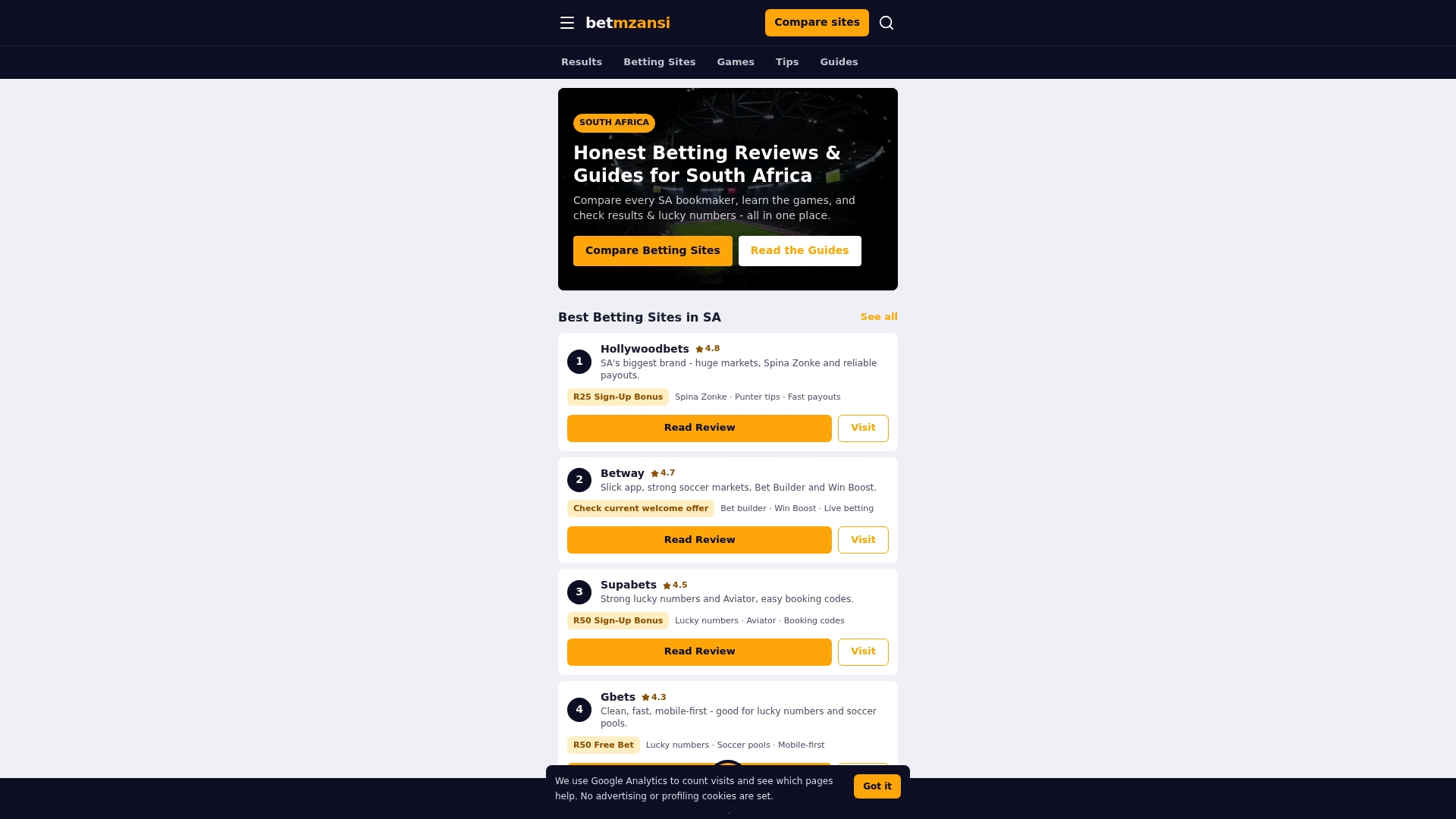
Our licensed bookmaker reviews break down provincial licence numbers, withdrawal speeds, and FICA requirements for every major operator serving South African players, so you’re not hunting through terms and conditions on your own. Confused by a term in an operator’s rules? The betting glossary clears up licensing and betting jargon in plain language. If you’re weighing sign-up offers, our guide to promo codes and welcome bonuses flags which bonuses come from properly licensed sites and which come with fine print worth avoiding. Start with our current list of licensed betting sites before you register anywhere new.
This article is general information, not a substitute for advice from a qualified lawyer. Consult a qualified legal professional about your own circumstances before acting on anything here.
Sources
- National Gambling Act 7 of 2004 | South African Government
- National Responsible Gambling Programme (NGB)
- Game Over: South Africa reasserts its ban on online gambling
- Gambling Laws and Regulations Report 2026 South Africa