Six Step Player Props Workflow You Can Use Tonight in South Africa
Use a six step workflow to read player props, compare odds, and manage risk. Practice the checklist on licensed South African bookmakers before you bet.

A player prop is a bet on one player’s statistical output in a single game, not on which team wins. You pick whether that player goes over or under a number the sportsbook sets, like 24.5 points or 1.5 assists, and the odds attached tell you the payout. This guide walks casual bettors through reading a prop, spotting the common types, and running a simple analysis before risking money.
TL;DR:
- Line shopping across multiple licensed sportsbooks can significantly improve profitability by exploiting small differences in odds and prices.
- Sharp bettors prioritize analyzing player volume, matchup quality, injury reports, game environment, recent form, and market pricing before placing bets.
- Prop market hold ranges from 4% to 6% for star players, but exotic and live props can have holds up to 20%, increasing the bookmaker’s margin.
- Public bias heavily influences popular star-players’ overs, creating value on the less-bet side when a projection indicates a likely underperformance.
- Consistent practice using real markets and comparing projections against posted lines is the best way for beginners to develop profitable betting skills.
Table of Contents
- Player Props Explained: How to Read the Line
- Common Types of Player Prop Bets by Sport
- The Six-Input Workflow for Analyzing Any Prop
- Smart Strategy and Risk Management for Prop Bettors
- How Sportsbooks Price and Move Player Prop Lines
- How Bet-mzansi Helps You Build These Skills
- Where to Practice What You Just Learned
- Sources
- FAQ
Player Props Explained: How to Read the Line
Every player prop board follows the same four-part structure: player name, stat category, the line, and odds for each side. LeBron James, points, 24.5, and then a price like -115 for the over and -105 for the under. That’s the whole grammar of a prop bet, and once it clicks, every sportsbook board on earth becomes readable.
The line itself usually lands on a half-point specifically to prevent a tie. Books set 24.5 instead of 24 because a player scoring exactly 24 would otherwise trigger a push, a refund where your stake just comes back with no winner. Whole-number lines do exist, mostly in stats like rebounds or made threes where books are comfortable eating the occasional push.
Odds tell you what the sportsbook thinks will happen, converted into a price. Turning American odds into implied probability takes two quick formulas:
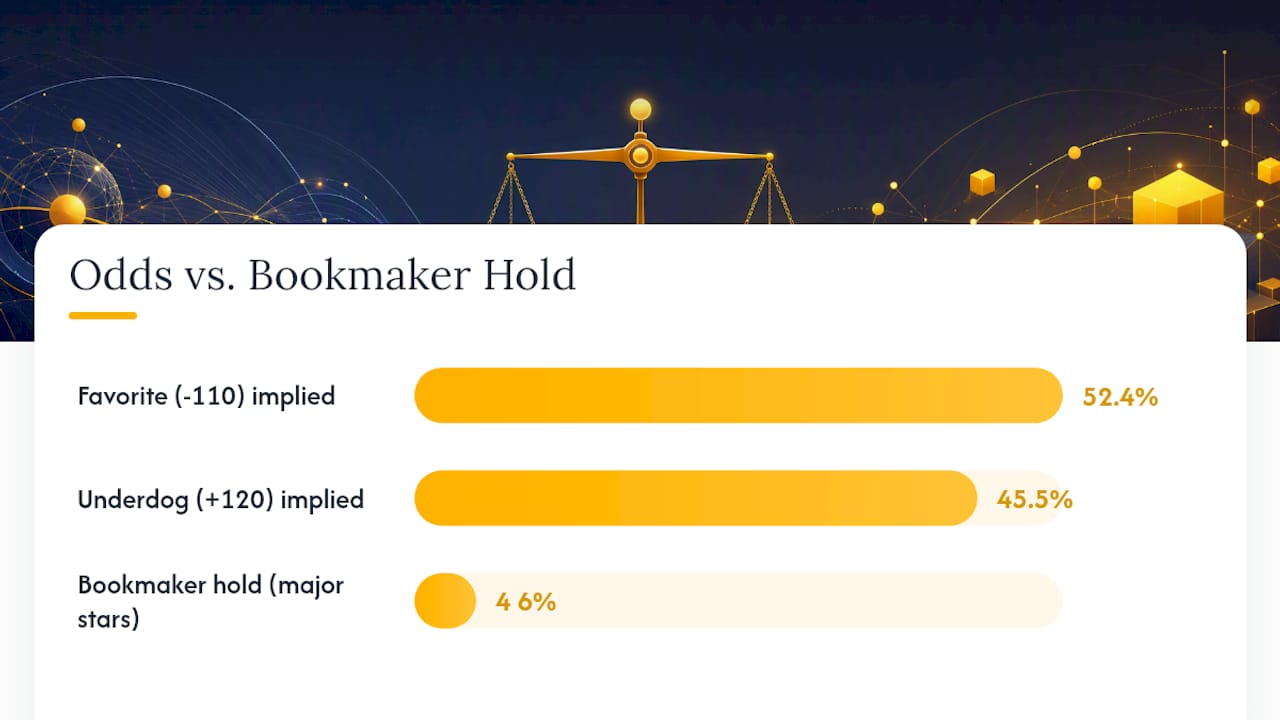
- Negative odds (favorites): divide the absolute value of the odds by itself plus 100. At -110, that’s 110 ÷ 210, or about 52.4%.
- Positive odds (underdogs): divide 100 by the odds plus 100. At +120, that’s 100 ÷ 220, or about 45.5%.
You need to clear that break-even number just to profit long term, which is why understanding how odds work matters more than most beginners assume.
Sport-specific quirks trip people up fast. NFL props typically void or adjust for overtime depending on the book’s house rules, so a receiver’s yardage prop might settle at the end of regulation on some sites and include OT on others. NHL props involving shootouts usually exclude shootout goals from the count. MLB extra innings generally count toward props unless the book states otherwise. Always check the site’s specific settlement rules before assuming.
Statistic: Hold on major star-player props typically runs between 4% to 6%, meaning the sportsbook’s built-in edge is relatively thin compared to riskier markets covered below.
Common Types of Player Prop Bets by Sport
Prop depth varies enormously by sport and by how much attention a game gets. Marquee matchups get dozens of props; a Tuesday night game between two mediocre teams might get a handful.
- NBA: points, rebounds, assists, three-pointers made, and combo props like points plus rebounds plus assists (PRA) are the bread and butter, with stars like Nikola Jokic seeing 15 or more individual markets on a given night.
- NFL: passing yards, receiving yards, receptions, rushing yards, and touchdown scorer props dominate, with quarterbacks and top receivers drawing the deepest markets.
- MLB: total bases, hits, strikeouts (for pitchers), and home run props are standard, though home run props carry notoriously high variance since they’re rare, binary events.
- Soccer: shots on target, tackles, passes completed, and anytime goalscorer props lead the board, with goalscorer props often the most heavily bet market outside the match result itself.
- NHL: shots on goal, points (goals plus assists), and saves for goalies fill out most boards, though depth here trails the NBA and NFL.
NBA and NFL markets tend to be the deepest and sharpest because of betting volume, which usually means tighter pricing. Exotic props, think “will a player record a triple double” or “first basket scorer,” carry meaningfully higher hold in the 10% to 20% range, since books price in more uncertainty and expect less line shopping on niche markets.
The Six-Input Workflow for Analyzing Any Prop
Sharp prop analysis boils down to six checks, run in a specific order, comparing your own projection against the market’s implied number rather than trusting a gut feeling. Experts at CBS Sports frame this as systematic comparison against a baseline, and that discipline is what separates a repeatable process from random guessing.
- Volume first. Check expected minutes, touches, or plate appearances. A player without opportunity can’t hit a counting-stat prop no matter how efficient he is, which is why analysts consistently flag usage as the gating factor before anything else.
- Matchup quality. Is the opposing defense weak against this stat category? A center facing a team that allows the third-most rebounds in the league is a different bet than one facing an elite rebounding unit.
- Injury status. Check the latest injury report for the player himself and for teammates whose absence might shift usage his way.
- Game environment. Look at the total (over/under) and pace projection. High-total games mean more possessions, more plays, and generally more stat opportunities for everyone involved.
- Recent form. Weight the last five to ten games more heavily than season averages, but watch for role changes that make recent samples unreliable.
- Market pricing. Convert the posted odds to implied probability and compare it against your own projected probability.
Here’s how that plays out on a fictional NBA points prop: a wing player is listed at 22.5 points, priced at -110 on both sides (52.4% implied). He’s projected for 34 minutes tonight (strong volume) against a defense ranked 24th against his position (favorable matchup). No new injuries. The game total sits at 235, above league average (fast environment). He’s averaged 25 points over his last seven games (strong form).
Pro Tip: Always compare like-for-like markets across books before locking in your projection. A -110 line at one book and a -125 line at another for the identical 22.5 total means you need very different win rates to break even, and skipping that check is the single most common beginner mistake.
Smart Strategy and Risk Management for Prop Bettors
Line shopping is the fastest edge available to a beginner, and it costs nothing but a few extra minutes. A half-point difference on a rebounds prop, or a -110 versus -125 price on the same total, changes your break-even win rate meaningfully over a season of bets. Comparing licensed South African bookmakers before placing a wager should become automatic.
Alternate lines let you shift the threshold up or down for a different price, useful when you like a player’s direction but think the standard line is priced too aggressively. They make less sense when you’re just chasing a better number without a real analytical reason for moving off the main line.
Live props open short windows tied to in-game events, like a lowered scoring total after a player picks up early fouls or an injury scare that briefly reprices minutes-based markets. These require fast decisions and a clear head, not impulse.
A few practical rules:
- Cap any single prop bet at 1% to 2% of your total bankroll, regardless of how confident you feel.
- Skip props built on sample sizes under five recent games; the data simply isn’t stable yet.
- Be wary of confusing role changes, like a bench player suddenly starting, where recent history stops predicting future performance.
- Watch for heavy public bias on star players’ overs, since systematic public tendencies toward popular names can create value on the less-loved side of a line.
Pro Tip: If you can’t articulate why a line moved in one sentence, don’t bet into it blind. “Sharp money hit the under” is a reason. “It just felt right” is not.
How Sportsbooks Price and Move Player Prop Lines
Sportsbooks build in a profit margin called hold or juice on every prop, and that margin varies a lot by market type. Major star props typically hold 4% to 6%, secondary player props run 6% to 10%, exotic props climb to 10% to 20%, and live in-play props commonly sit at 8% to 15%.
| Prop type | Typical hold |
|---|---|
| Major star props | 4% to 6% |
| Secondary player props | 6% to 10% |
| Exotic props | 10% to 20% |
| Live/in-play props | 8% to 15% |
Asymmetric pricing, where the over is -120 and the under is -105 on the same line, signals the book expects more action or has more confidence on one side. Line movement itself is driven by sharp money hitting early, breaking news like a lineup change, and public betting volume nudging lines gradually toward the popular side. Same-game parlays stacking correlated props, like a quarterback’s passing yards with his top receiver’s receiving yards, often carry underpriced correlation risk that the combined odds don’t fully account for.
How Bet-mzansi Helps You Build These Skills
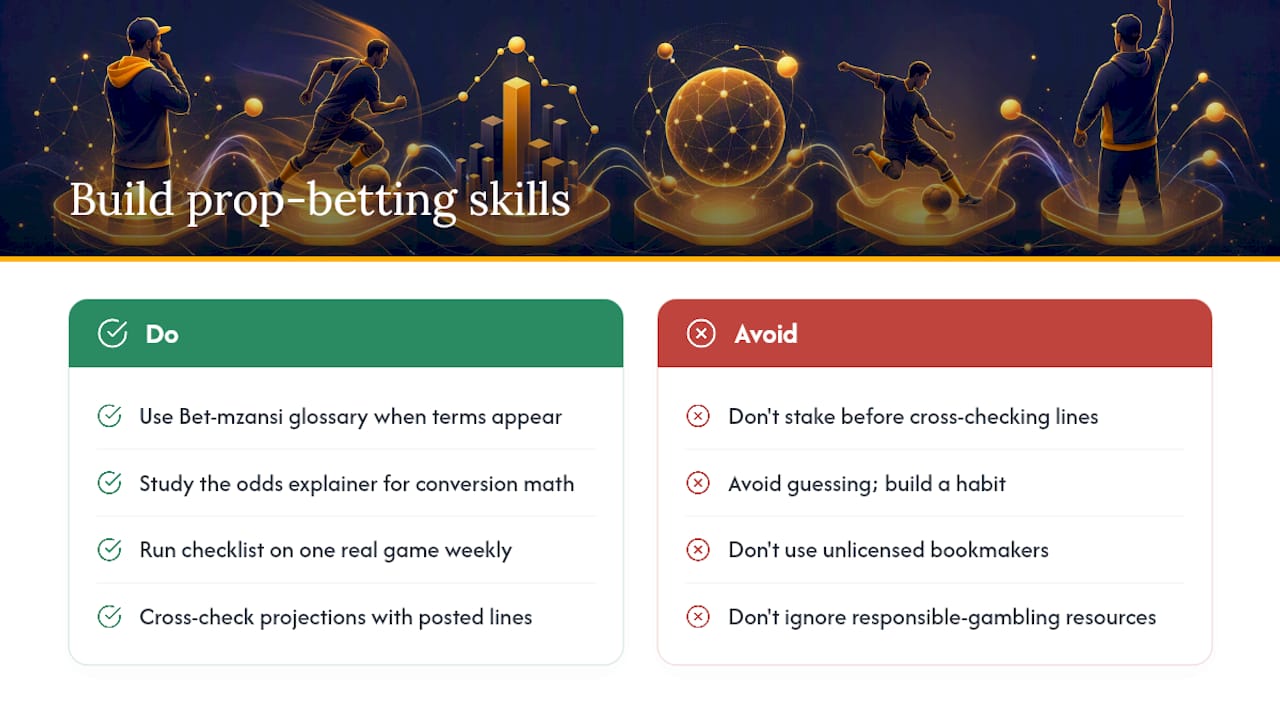
Reading a prop line correctly is a skill, and it improves fastest when you pair a framework with real practice on live markets. Bet-mzansi’s betting glossary clears up terms like juice, hold, and push the moment you hit them, while the odds explainer walks through the exact conversion math used in the six-input workflow above.
Run the checklist on one real game a week using licensed South African bookmaker boards, and cross-reference your projections against posted lines before you ever stake money. That habit, more than any single tip, is what separates bettors who improve from bettors who guess. Responsible-gambling resources through BeGambleAware are worth bookmarking too, given how much higher the variance runs on single-player markets than on straight game bets.
— Nkosi
Where to Practice What You Just Learned
Reading this guide gets you the framework. Applying it takes a place to actually compare prices, and that’s the gap most beginners hit once they leave the theory behind. Some websites consolidate licensed South African bookmakers side by side, so line shopping isn’t a matter of opening six browser tabs, it’s one page.

Start with the betting glossary to lock down terms like hold, push, and implied probability if any of them still feel shaky. From there, the learn hub organizes structured lessons on odds, staking, and strategy in one spot instead of scattered across forum threads. When you’re ready to compare actual boards and line-shop the way this guide recommends, the list of licensed betting sites in South Africa is the place to start.
Sources
- Prop betting — CBS Sports
- Player Props: Understanding the math behind the lines — Wizard of Odds
- How to read player props — Sports Command
FAQ
How do player prop bets work?
You bet whether a specific player will go over or under a statistical line set by the sportsbook for that game. Your payout depends on the odds attached to whichever side you pick, and you can calculate your break-even win rate using the odds-to-probability formulas covered earlier in this guide.
Can you give examples of prop bets?
Common examples include “LeBron James Over 24.5 points” or “Erling Haaland to score anytime.” Each follows the same structure: player, stat, line, and odds on both sides.
How do I read a prop bet correctly?
Look at the four parts in order: the player’s name, the stat category, the numerical line, and the odds for over and under. Check whether the line is a half-number (no push possible) or a whole number (a push refunds your stake if the exact total hits), and confirm the sportsbook’s overtime or extra-innings settlement rules before betting.
How do I see which player props get the most action?
Most licensed sportsbooks show a “most popular” or “trending” tab on their props page, and marquee matchups between star players typically draw the heaviest volume. Comparing that popularity against your own six-input projection is exactly how you spot value on the less-bet side of a line, since public bias tends to inflate prices on star players’ overs.