Cricket Betting Explained: A Beginner's Guide to Odds and Markets
pattern — the “Explained: A Beginner’s Guide” frame is a stock template. Fail. - CTR and concrete detail: The draft offers no specific, article-sourced...

Cricket betting means predicting a match outcome, like the winner, top run scorer, or total runs scored, and staking money on it through a licensed bookmaker whose odds reflect its assessment of probability. If you’re starting out, stick to the Match Winner market and learn decimal odds before risking bigger sums. The rest of this guide walks through the process, the markets, the math, and how to bet without wrecking your bankroll.
TL;DR:
- Comparing odds across multiple sites and checking team news and toss results are crucial steps to avoid common beginner mistakes.
- Match Winner markets generally have lower bookmaker margins, making them preferable for starting bets, while player props tend to carry higher margins.
- In-play odds fluctuate significantly during key game events, so waiting for innings breaks can reduce the risk of quick market overreactions.
- Setting a fixed bankroll and staking only 1 to 2% per bet helps prevent losses from emotional betting and improves long-term discipline.
- Considering pitch reports and weather conditions before betting can significantly influence match outcome expectations, especially in ODIs and Tests.
Table of Contents
- How to Place Your First Cricket Bet
- Types of Cricket Bets and Markets You Will See
- Cricket Odds Explained: Decimal, Fractional, and American Formats
- In-Play Betting: How Odds Move and When It Matters
- Beginner Strategy and Bankroll Management
- Cricket Formats and How They Change Your Betting Approach
- Common Mistakes, Red Flags, and Responsible Gambling
- Legal Considerations and Regulations for Cricket Betting
- Weather, Pitch Reports, and How They Shape a Bet
- Using Statistics and Form Guides to Inform Your Bets
- Bookmaker Offers, Bonuses, and Promotions Explained
- Bet Mzansi’s Take on Learning Cricket Betting
- Sources
How to Place Your First Cricket Bet
Start with a fixture that gets heavy media coverage. Team news, pitch reports, and injury updates are much easier to find for a marquee international match than an obscure domestic T20 game, and that information gap matters more than most beginners realize.
Once you’ve picked the match, follow this sequence:
- Choose your market. Match Winner is the simplest and most liquid option for a first bet.
- Compare odds. Check the price across two or three licensed betting sites before committing.
- Check team news and the toss. Batting first or second changes win probability significantly on certain pitches.
- Enter your stake. Type in the amount you want to risk, not the amount you want to win.
- Confirm the bet slip. Review the odds and stake one last time before submitting.
Here’s the math in action: if you stake $20 on a team priced at 1.80 in decimal odds, your potential payout is stake × odds, or $36 total, meaning a profit of $16. That’s the entire calculation. No formulas beyond multiplication.
Pro Tip: Before you confirm anything, run through a four-point checklist: odds compared across sites, team news read, toss result known (if available), and stake within your bankroll limit. Skipping any one of these is how beginners lose money on bets that looked obvious.
Types of Cricket Bets and Markets You Will See
Cricket betting sites offer far more than picking a winner, and knowing which markets exist helps you avoid ones that are stacked against you as a newcomer.
- Match Winner: Betting on which team wins the match outright. The most straightforward market and usually the most competitively priced.
- Outrights or Series Winner: Betting on the overall winner of a tournament or series before it starts, which locks in your prediction for weeks.
- Over/Under Totals: Betting on whether total runs, wickets, or overs faced will go above or below a set number.
- Handicaps: One team gets a run advantage or disadvantage added to the final score, which levels an otherwise lopsided matchup.
- Player Props (Top Batsman, Top Bowler): Betting on individual performance rather than team outcome. These carry more runners and more variance.
- Niche Markets: Coin toss winner, next wicket method, or dismissal type. Fun to bet occasionally, but liquidity is thin and prices move fast.
Market selection isn’t just about picking what sounds interesting. Match Winner markets tend to carry the lowest overround, the bookmaker’s built-in margin, while multi-runner player props carry a much heavier one. That difference alone should steer a beginner’s first several bets.
Cricket Odds Explained: Decimal, Fractional, and American Formats
Odds are just probability dressed up in different notation, and once you can read one format, the others take five minutes to learn.
- Decimal odds (e.g., 1.80): Multiply your stake by the number to get your total payout, including your original stake.
- Fractional odds (e.g., 4/5): The first number is profit, the second is stake required. A $5 bet at 4/5 returns $4 profit plus your $5 back.
- American odds (e.g., -125 or +150): Negative numbers show how much you need to stake to win $100; positive numbers show how much you win on a $100 stake.
Converting any decimal price into implied probability uses one formula: (1 ÷ decimal odds) × 100. A price of 1.80 implies a probability of about 55.6%. Add up the implied probabilities of every outcome in a market and you’ll usually get more than 100%. That excess is the overround, the bookmaker’s cut baked into the price.
Spotting value means comparing that overround across bookmakers. Tighter markets, where implied probabilities sum closer to 100%, generally hand more of the edge back to you. A quick mental check: if one site prices a team at 1.90 and another at 2.00, the 2.00 line pays more for the same outcome. Small differences compound fast over dozens of bets.
In-Play Betting: How Odds Move and When It Matters
Pre-match odds are fixed the moment you place your bet. In-play odds shift continuously, reacting to what’s happening on the field in real time.
The events that move live prices most:
- The toss: Batting first or chasing changes win probability instantly, especially with dew or spin-friendly conditions.
- Powerplay overs: A fast start or early collapse swings the market hard in the first six overs.
- Quick wickets: Two or three wickets falling in a short span can flip favorites within minutes.
- Innings break: The score is set, information is complete, and prices settle before the chase begins.
- Death overs: The final overs of a T20 or ODI innings see wild price swings as boundaries and dot balls trade momentum back and forth.
T20 odds can update well over 100 times per innings, which makes it the fastest and riskiest format for live betting if you’re still learning how markets react.
Pro Tip: If you’re new to in-play betting, wait for the innings break. The first team’s total is locked in, you know exactly what the chasing side needs, and the market hasn’t yet overreacted to the opening overs the way it will three balls into a chase.
Beginner Strategy and Bankroll Management
The single biggest lever for a new cricket bettor isn’t picking winners better. It’s not blowing up your account while you learn.
- Set aside a dedicated bankroll. Money you can afford to lose entirely, separate from other funds.
- Stake 1 to 2% per bet. On a $200 bankroll, that’s a $2 to $4 stake per wager, a rule widely recommended for new bettors.
- Use fixed stakes, not chasing. Never increase a bet size to recover a previous loss.
- Log every bet. Market, odds, stake, and result. Patterns only show up after 30 or 40 bets.
- Graduate slowly. Move into prop or live markets only after you’ve tracked results and learned specific venue or player trends.
The most reliable early habit isn’t sharper prediction, it’s discipline around stake size. Bet Mzansi’s guide to bankroll management breaks down fixed-stake systems in more detail if you want a deeper dive.
Cricket Formats and How They Change Your Betting Approach
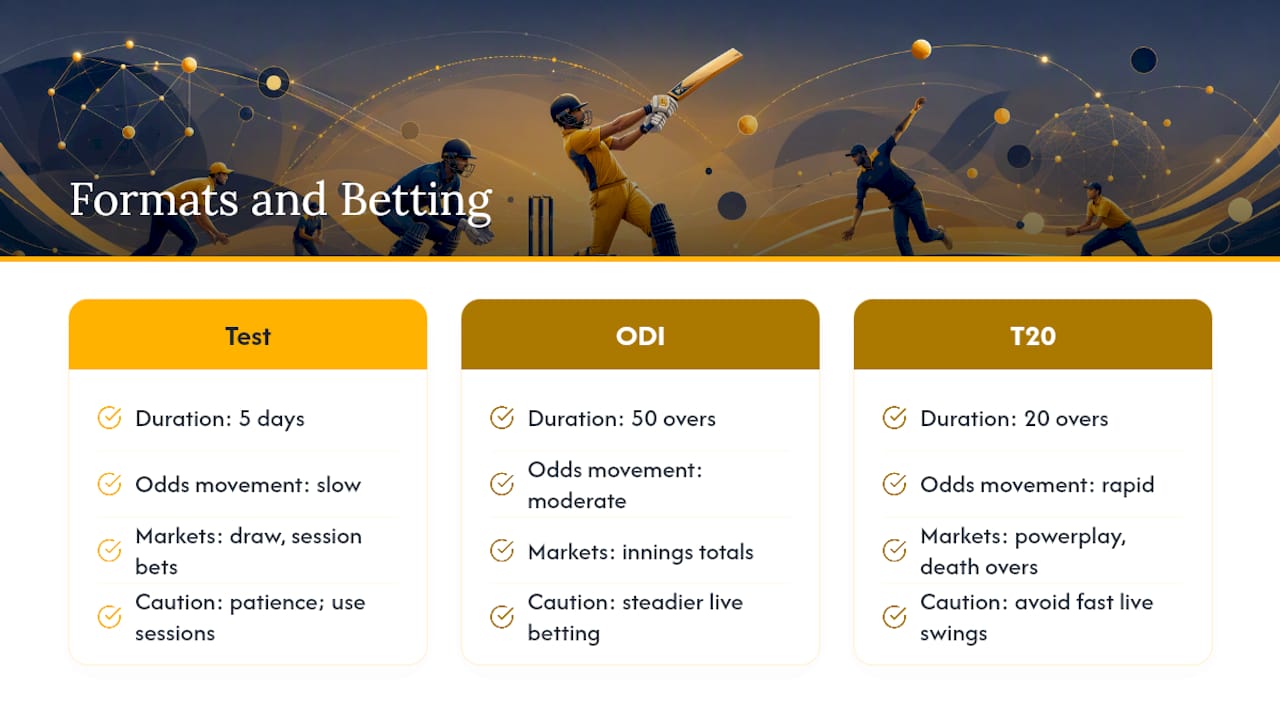
Test matches, ODIs, and T20s behave completely differently as betting products, and treating them the same is a common beginner mistake.
Tests unfold over five days, so odds move slowly and draw markets and session betting become relevant options. ODIs sit in the middle: 50 overs per side gives enough data to judge innings totals without the chaos of a shorter format. T20 is the volatile one. Powerplay results and death-over swings can flip a match in minutes, which is exactly why it demands more caution, not more action, from someone new to live markets.
Common Mistakes, Red Flags, and Responsible Gambling
Novice bettors tend to make the same handful of errors repeatedly, and most beginner guides converge on the same list:
- Betting emotionally on a favorite team rather than the actual odds.
- Chasing losses by increasing stake size after a bad result.
- Skipping odds comparison and settling for the first price seen.
- Overusing in-play and prop bets before understanding pre-match markets.
Watch for red flags too: a site restricting your bonus without explanation, unclear licensing information, or withdrawal delays with no support response. Bet Mzansi’s responsible gambling page covers deposit limits and self-exclusion tools worth setting up before your first deposit, not after a rough week.
Legal Considerations and Regulations for Cricket Betting
Cricket betting legality depends entirely on where you live, and there’s no single global answer. Some countries license and regulate online sportsbooks directly, issuing operators formal permits and requiring identity verification before you can deposit. Others restrict betting to specific licensed operators or state-run channels. A smaller group bans it outright, treating unlicensed wagering as a criminal offense regardless of where the bookmaker is based.
The safest rule of thumb: only bet with a bookmaker holding a license recognized in your jurisdiction. Licensed operators are required to verify your identity, a process often called FICA in South Africa, and to follow rules around responsible gambling tools, fair payout terms, and dispute resolution. An unlicensed offshore site might offer flashier odds, but you lose every legal protection the moment something goes wrong with a withdrawal or a disputed bet.
Regulations also shift over time. A market that was gray or informally tolerated five years ago may now have a formal licensing framework, and vice versa. Before depositing anywhere, confirm the operator’s current license status directly rather than relying on an old review or a forum post. Bet Mzansi’s comparison of licensed South African bookmakers only features operators holding valid local licenses, which removes the guesswork for readers betting from South Africa specifically.
If you’re traveling or betting from a jurisdiction you’re unfamiliar with, treat the legal question as separate from the betting question. Confirm you’re allowed to bet first. The best odds in the world don’t matter if the operator can’t legally pay you.
Weather, Pitch Reports, and How They Shape a Bet
A cricket pitch is never neutral. Some surfaces favor fast bowlers with extra bounce and seam movement early in an innings. Others turn into flat batting tracks where 300plus totals become routine, or crumble into spin-friendly minefields by day three of a Test.

Pitch reports, usually released a few hours before the toss, tell you what the ground staff and commentators expect from the surface. A pitch described as “green” or “grassy” tends to help bowlers, particularly at the start of an innings. A “dry” or “cracked” surface usually favors batters early and spinners later. Ignoring this report before placing a Match Winner or totals bet is like ignoring a form guide entirely.
Weather adds another layer, especially overcast conditions or dew. Overcast skies often assist swing bowling, shifting early-innings advantage toward the bowling side. Dew in evening matches, common in day-night fixtures in humid regions, makes the ball harder to grip, which typically favors the team batting second, since bowlers struggle to spin or seam the ball as effectively. That’s part of why toss decisions swing so heavily on conditions, and why the toss itself moves live odds so quickly once it’s announced.
None of this means you need a meteorology degree. It means checking the pitch report and weather forecast before locking in a total or handicap bet takes five minutes and meaningfully improves your read on the match, particularly in formats like ODIs and Tests where conditions have more time to influence the outcome.
Using Statistics and Form Guides to Inform Your Bets
Recent form matters more than reputation. A team ranked highly six months ago but on a three-match losing streak carries different momentum than the ranking suggests, and odds don’t always fully adjust for a slump until it’s confirmed on the field.
Look at head-to-head records at the specific venue, not just overall team form. Some teams dominate at home grounds where conditions suit their bowling attack, then struggle badly away. Individual player statistics matter even more for prop markets: a top batsman market bet should factor in that player’s recent average against the specific bowling attack they’re facing, not just their career numbers.
Powerplay and death-over statistics are worth tracking separately in white-ball formats, since a team’s overall run rate can hide a weakness in one specific phase of the innings. A side that scores heavily in the middle overs but collapses in the powerplay is a different betting proposition than the raw average suggests.
Form guides published by cricket news sites and betting resources compile this data, but the habit that actually pays off is building your own simple tracking system: recent results, venue records, and key player form for the teams you follow most. That’s more useful long term than any single tip, and it pairs directly with the bet-logging habit mentioned earlier in the bankroll section.
Bookmaker Offers, Bonuses, and Promotions Explained
Not all sign-up offers are structured the same way, and the differences matter more than the headline number suggests.
A welcome bonus typically matches a percentage of your first deposit, often with wagering requirements attached, meaning you must bet through the bonus amount a set number of times before withdrawing any winnings. A free bet gives you a fixed-value token to place on a specific market, and if it wins, you usually collect the profit but not the original stake. Odds boosts temporarily increase the price on a specific selection, often tied to a big match, and work best when the boosted market is one you’d have bet anyway. Cashback promotions refund a portion of losses over a set period, which softens variance but rarely eliminates it.
The fine print decides whether a promotion is genuinely valuable. Wagering requirements, minimum odds restrictions, and time limits on free bets can quietly erode the headline value of an offer. Bet Mzansi’s breakdown of betting bonuses walks through how to read those terms before claiming anything, and identifying genuine value in a promotion is the same skill as spotting value in odds markets generally: read past the headline number to what you actually walk away with.
Bet Mzansi’s Take on Learning Cricket Betting
Most beginner guides overload new bettors with strategy before they’ve placed a single bet, and that’s backward. The order that actually works is simpler: place a few small, low-stakes Match Winner bets first, track every result, and only then start layering in props, live markets, or format-specific tactics.
What gets underestimated constantly is how much of long-term success comes down to staking discipline rather than prediction skill. A bettor who correctly picks winners 55% of the time but stakes erratically will often finish behind a bettor who picks winners only 50% of the time but sticks rigidly to a 1 to 2% staking rule. The math of variance punishes inconsistency far more than it rewards a slight edge in judgment.
Bet Mzansi built its learning resources around that principle: fewer flashy predictions, more emphasis on the mechanics that keep a bankroll intact long enough for skill to actually matter. If you’re still shaky on terminology, the betting glossary covers the terms this guide assumes you already know, and the betting strategy basics page goes deeper into the staking framework introduced above.
— Nkosi
Sources
- Cricket Explained: Betting and Tips
- Cricket Betting Odds Explained (2026) | Beginner Guide
- Live Cricket Betting Guide | In-Play Odds & Strategy
- A Beginner’s Guide to Cricket Betting: How to Place Your First Bet