1.25 and the Math: When Double Chance Is Worth It in South Africa
Learn when Double Chance protects your stake in South Africa. See the 90 minute rule, a 1.25 odds check, and quick betting tips.
Double chance is a single bet that covers two of a match’s three possible results, shown as 1X, X2, or 12. Choosing 1X wins if the home team wins or the match draws, X2 wins on a draw or an away win, and 12 wins on either team winning outright. You get a higher win probability than a straight match-result bet, but a smaller payout, and it’s judged strictly on the 90 minutes plus stoppage time.
TL;DR:
- Double chance bets cover two outcomes in a match, reducing winning odds but increasing the probability of a stake settling in your favor.
- It applies to full-time, half-time, and second-half results, with full-time double chance being the most commonly used.
- Prices are always more expensive than implied probabilities suggest due to bookmaker margins, so always compare odds and run the math before betting.
- Double chance is most valuable when backing a strong favorite against a weaker team or when expecting a low-scoring, tight match.
- Always remember that double chance is settled on the 90-minute result, including stoppage time, and extra time or shootouts generally do not count unless specified.
Table of Contents
- What Is Double Chance Betting and How Does It Work?
- Full-Time, Half-Time, and Second-Half: Where Double Chance Applies
- Why Double Chance Pays Less and How to Spot Value
- When Double Chance Fits Your Betting Strategy
- Bookmaker Rules and Mistakes That Cost Bettors Money
- Worked Examples: Winning and Losing a Double Chance Bet
- Why Trust This Breakdown
- Quick Takeaways Before You Bet
- The Real Question Isn’t What Double Chance Is, It’s Whether You Need It
- Sources
What Is Double Chance Betting and How Does It Work?
A standard football match has three possible outcomes: home win, draw, away win. That’s the 1X2 market. Double chance takes that same market and merges two of the three outcomes into one wager, using one stake rather than two separate bets glued together.
- 1X wins if the home team wins or the match ends level.
- X2 wins if the match ends level or the away team wins.
- 12 wins if either team wins, and only a draw loses.
You’re not placing two bets and hoping one lands. It’s one ticket, one stake, settled by one final result. The odds themselves come from combining the implied probabilities of the two covered outcomes from the standard 1X2 line, then the bookmaker layers its margin on top. That’s why the price you see is never quite as generous as simple math would suggest. It’s also why double chance shows up right next to the regular match-result market on most bet slips rather than buried in a separate section.
Full-Time, Half-Time, and Second-Half: Where Double Chance Applies
Double chance isn’t limited to the final result. Bookmakers typically offer it across three separate windows of the same match, each with its own judgment point:
- Full-time double chance settles on the 90-minute result (plus stoppage), the version most bettors use.
- Half-time double chance settles the instant the referee blows for the interval, ignoring anything that happens after.
- Second-half double chance looks only at goals scored from the 46th minute onward, treating the second half like its own mini-match.
Soccer is the sport built for this because it’s one of the few major sports where a draw is a genuine, common outcome. Advanced bettors sometimes wait until they’ve watched the first half live before placing a half-time or second-half double chance, using what they’ve actually seen on the pitch rather than pre-match assumptions.
Why Double Chance Pays Less and How to Spot Value
Covering two outcomes instead of one obviously raises your odds of winning, and bookmakers price that in by shortening the payout. That trade-off is the entire concept in one sentence: more ways to win, smaller reward for winning. Whether a specific price is actually worth backing depends on comparing the bookmaker’s implied probability against your own honest read of the match.
Statistic Callout: The Math Behind the Price Say a bookmaker prices a match at 2.20 for the home win and 3.40 for the draw. Divide that into 1 to get the “fair” double chance price. If the book actually offers 1.25, that gap is the bookmaker’s margin at work. You can run this same subtraction on any betting odds before you commit a stake.
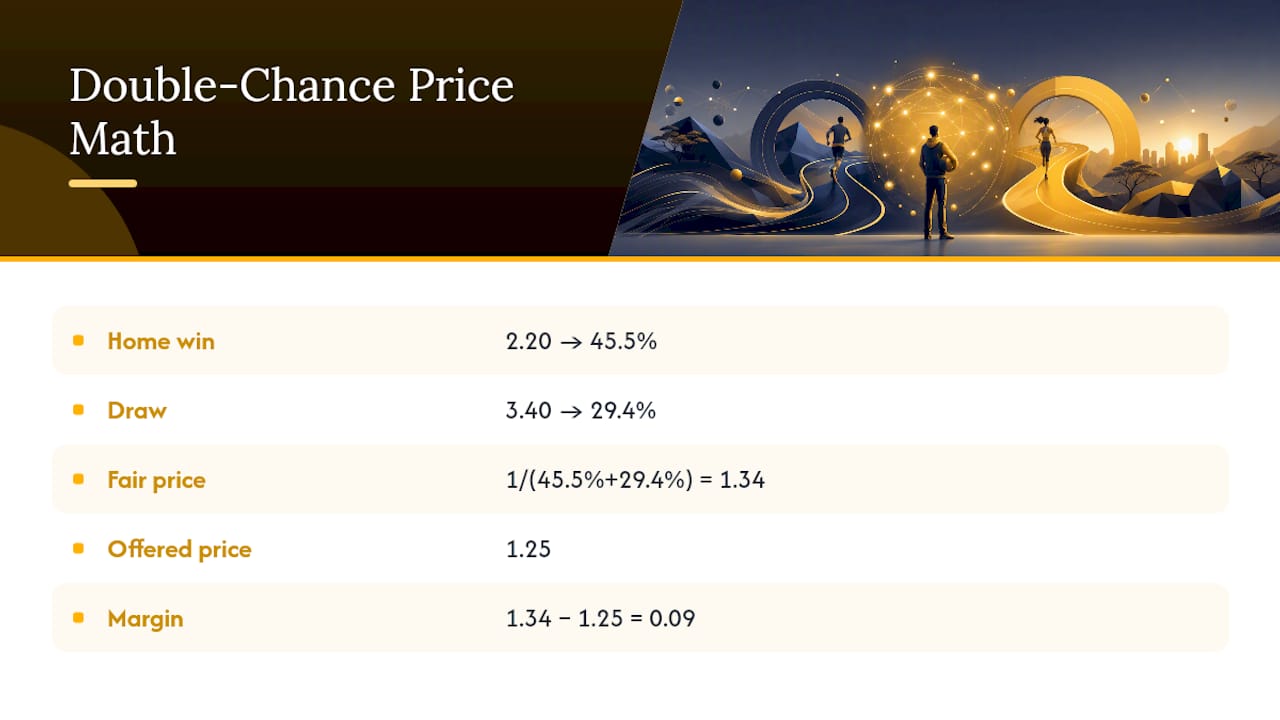
The lesson here isn’t that double chance is a bad bet. It’s that the “safety” you’re paying for has a price tag, and that price tag is always a little steeper than the raw math implies.
When Double Chance Fits Your Betting Strategy
Double chance earns its place in specific situations, not as a default pick for every match on the card.
- Backing a strong favorite who might stumble. A top side at home against a mid-table opponent rarely loses outright, so 1X protects against an unlucky draw while still cashing on a win.
- Backing an underdog who just needs to survive. X2 suits a team that’s solid defensively but unlikely to win outright, letting you profit from a draw without needing an upset.
- Genuinely tight matchups with no clear favorite. The 12 option skips the draw entirely, useful when you’re confident someone wins but have no read on who.
Double chance legs also show up inside accumulators, where bettors use them to de-risk one shaky leg without sacrificing the whole slip. The downside is obvious: a parlay full of double chance selections compounds small odds into an unimpressive total payout. If you’re chasing bigger returns on a clear favorite, a straight moneyline, draw no bet, or Asian handicap often makes more sense than double chance.
Pro Tip: Before locking in a double chance bet, price out the straight win on its own. If the gap between the two isn’t wide enough to justify the extra safety, you’re better off backing the outcome you actually believe in.
Bookmaker Rules and Mistakes That Cost Bettors Money
The single rule that trips people up most: double chance is judged on the 90-minute result, including stoppage time. Extra time and penalty shootouts don’t count unless the market explicitly says otherwise, which matters a lot in cup and tournament football.
- Don’t confuse double chance with an each-way bet or two separate stakes stitched together. It’s one bet, one payout line.
- Don’t mix up half-time and full-time versions when scanning the bet slip. They look nearly identical and settle completely differently.
- Always check the market description on a knockout match before assuming a comeback in extra time saves your ticket.
Read the specific bookmaker’s terms before betting, and if the stakes feel bigger than they should, GambleAware offers free, confidential support.
Worked Examples: Winning and Losing a Double Chance Bet
- Favorite avoiding defeat. A home side priced at 2.20 to win and 3.40 for the draw carries a 1X price around 1.25. If the match ends 1-1 or the home team wins 2-0, the bet cashes. If the away team wins, it loses, full stop.
- Underdog avoiding loss. A road team unlikely to win outright but capable of holding on gets backed with X2. A 0-0 draw or a 1-0 away win both pay. A home win kills it.
- The implied-probability check. Add the two decimal odds’ implied probabilities (1 ÷ 2.20 plus 1 ÷ 3.40), then compare that sum to 1 divided by the actual double chance price offered. The difference is the bookmaker’s built-in edge.
Why Trust This Breakdown
Bet-mzansi built this guide around how double chance actually settles in practice, not just the textbook definition. Author Nkosi draws on years spent comparing licensed South African bookmakers and their market rules to cut through confusing bet-slip language.
For deeper reading, check how betting odds work, browse the betting glossary for quick term lookups, or review bankroll management basics. When in doubt about a specific market, the bookmaker’s own terms and conditions are the final word, not a forum post or a friend’s guess.
Quick Takeaways Before You Bet
- Confirm the 90-minute rule applies before betting on cup matches.
- Calculate implied probability before trusting a price at face value.
- Keep stakes proportional using bankroll management principles.
- Use double chance selectively inside parlays, not as filler.
Ready to compare odds across licensed operators? Start with Bet-mzansi’s list of the best betting sites in South Africa to see who prices double chance markets most competitively, or head to the learning hub for more market breakdowns like this one.
The Real Question Isn’t What Double Chance Is, It’s Whether You Need It
Most explainers stop at the definition and call it a day. The part that actually matters is this: double chance is a hedge, and hedges cost money. The conventional advice treats it like a universal safety net for nervous bettors, but that framing undersells how often the “safe” price is quietly worse than it looks once you run the implied-probability math yourself.
Where I think bettors get it wrong is treating double chance as a substitute for match research instead of a tool that only works alongside it. If you can’t articulate why a draw is the live third outcome you’re protecting against, you’re just paying for peace of mind you haven’t earned. The 90-minute rule trips up more people than the odds math does, especially around knockout football, and that’s the detail worth memorizing before the math.
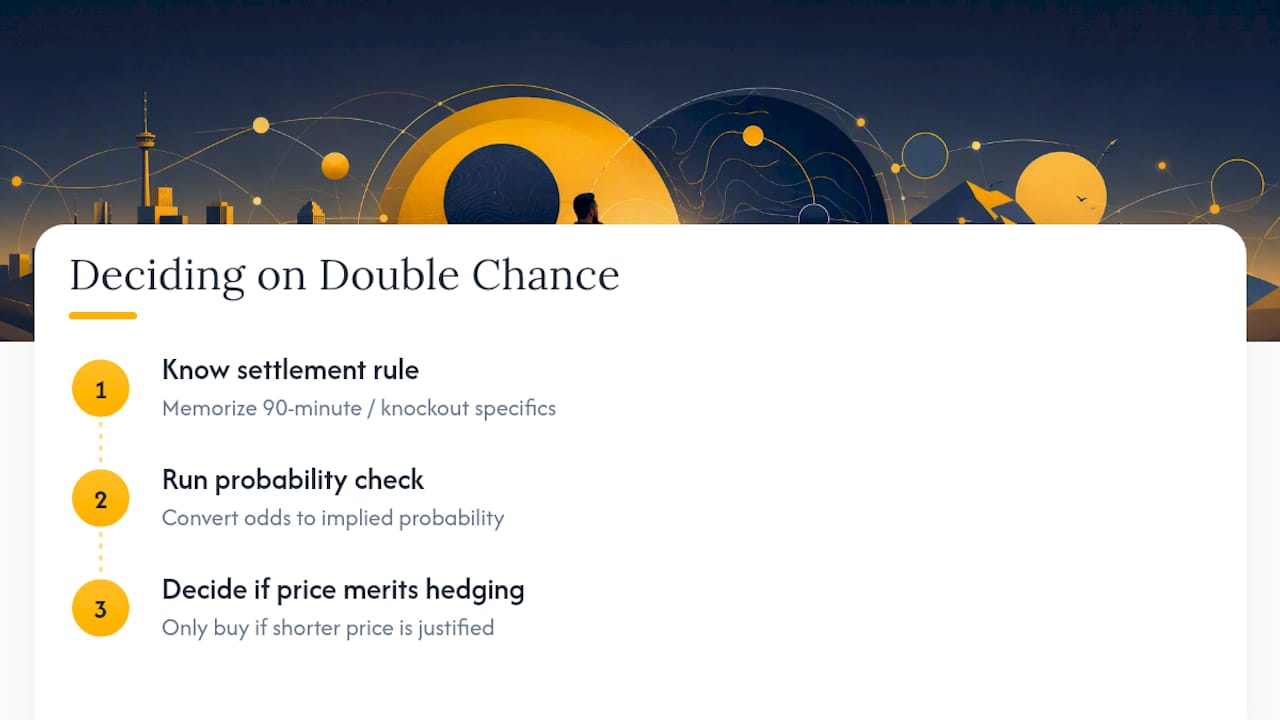
Prioritize this: know the settlement rule cold, run the probability check every single time, and only then decide if the shorter price is worth it. Skip the math and you’re just guessing with extra steps.
— Nkosi
Sources
- What is a double chance in soccer betting? | Action Network
- Double Chance & Draw No Bet Soccer Markets – Sportsbet Help Centre