Avoid Pushes and Split Stake Mistakes: Handicap Betting in South Africa
Move beyond moneyline bets with practical handicap examples. See how pushes and split stakes settle, and use a short checklist to spot value.

Handicap betting is a fixed-odds market where the bookmaker applies a virtual goal or point adjustment to one side before the match is settled, so your bet is judged on the adjusted final score rather than the actual one. It exists to make lopsided contests worth betting on. The main payoff: better odds and real value in matchups where a straight-win bet on the favorite pays next to nothing.
TL;DR:
- Asian handicap lines remove draws through half and quarter points, reducing push outcomes and increasing the chances of a clear win or loss for bettors.
- Whole-number Asian lines can result in pushes if the adjusted score ties, whereas quarter lines split stakes across two nearby lines, complicating settlement unless understood.
- To find value, bettors should analyze lineup changes, expected goals, and head-to-head trends rather than relying solely on the headline handicap line.
- Confusing European and Asian settlement rules causes significant payout misunderstandings, especially when a match ends with an exact margin or a draw.
- Handicap betting is legal under fixed-odds regulations, but bettors should confirm licensing and avoid confusing it with spread betting, which carries unlimited loss risk.
Table of Contents
- How Handicap Betting Explained: Notation and Settlement Work
- Types of Handicap Markets: European vs. Asian, and Half or Quarter Lines
- Reading Settlement Outcomes: Pushes, Refunds, and Exact-Margin Bets
- Worked Examples Across Football, Rugby, and Basketball
- How to Analyze Handicap Markets and Find Real Value
- Common Mistakes That Cost Handicap Bettors Money
- Key Takeaways for Using Handicap Bets Well
- The Origins of Handicap Betting and Why It Exists
- Handicap Betting vs. Fixed-Odds Betting: What’s Actually Different
- Regulatory Considerations Bettors Should Know
- A Working Bettor’s Take on Handicap Markets
- Keep Learning: Glossary, Strategy, and Line Comparisons
- Sources
How Handicap Betting Explained: Notation and Settlement Work
Every handicap line starts with a plus or minus sign attached to a number. A minus sign means that team is giving away a head start to the opponent; a plus sign means that team is receiving one. The favorite is always the one carrying the minus.
Say Manchester City is quoted at −1.5 against a struggling mid-table side. For your bet to win, City has to win by two goals or more. If City wins 2-1, you subtract 1.5 from their score, giving an adjusted result of 0.5 to 1. That’s a loss, even though City won the actual match, because handicap betting settles on the adjusted score, not the real one.
Here’s the mechanic in plain terms:
- A −1.5 favorite needs to win by 2+ goals to cash your bet.
- A +1.5 underdog covers if they win, draw, or lose by just 1 goal.
- The bigger the handicap, the longer the underdog’s odds and the shorter the favorite’s, since the bookmaker is pricing a wider gap.
- Odds tighten toward even money as the line grows, because the bookmaker is trying to balance action on both sides.
You’ll find these markets labeled “Handicap,” “Asian Handicap,” or “Spread” on most South African bookmaker interfaces, usually sitting right next to the standard 1X2 or moneyline market.
Types of Handicap Markets: European vs. Asian, and Half or Quarter Lines
Two structures dominate: European handicap and Asian handicap, and they settle very differently.
European handicap uses whole numbers (−1, −2, +1) and keeps the draw as a live outcome. Bet on a team at −1 and the match has to finish with at least a two-goal winning margin. Finish exactly one goal ahead, and the adjusted result is a draw, which Sky Bet’s own handicap rules confirm settles as a loss on a straight European handicap bet, unless you’ve backed the separate handicap-draw option in a 3-way market.
Asian handicap removes the draw entirely by using half numbers (−0.5, −1.5) or, when needed, quarter numbers (−0.25, −0.75). This is the format most South African punters mean when they talk about handicap betting rugby markets or soccer spreads.
- Half lines never push. Someone always wins the bet.
- Whole-number Asian lines (−1, −2) can push, meaning your stake is fully refunded if the adjusted score ties.
- Quarter lines split your stake across two adjacent lines. A −0.25 bet is really half your stake on 0 and half on −0.5.
Pro Tip: If a quarter line shows −0.25 and the match ends in a draw, half your stake pushes back and half loses. It looks confusing on a bet slip until you remember it’s just two mini-bets bundled into one.
Reading Settlement Outcomes: Pushes, Refunds, and Exact-Margin Bets
Settlement confusion is where most new handicap bettors lose money they didn’t need to lose. Three rules matter most.
- Pushes only happen on whole-number lines. If you bet a −1 handicap and the favorite wins by exactly one goal, the adjusted score is a draw, and your stake comes back rather than being lost or paid out.
- Split stakes apply automatically on quarter lines. Your bet slip will usually show the line as a single number like −0.25 or −0.75, but the bookmaker internally treats it as two equal bets on the two nearest half or whole lines.
- Handicap tie (exact-margin) markets are a separate, narrower bet where you predict the favorite wins by precisely the stated margin. These carry longer odds than a standard handicap because you’re betting on one specific scoreline rather than a range.
Handicap ties are a specialist play, not a beginner’s tool. They pay well when correct but hit far less often than a standard covering bet.
Worked Examples Across Football, Rugby, and Basketball
Numbers make this click faster than definitions. Here’s how the same logic plays out across sports with very different scoring patterns.
Football, Arsenal −1.5 vs. a relegation-threatened opponent:
- Arsenal wins 3-1 → adjusted score 1.5 to 1 → bet wins
- Arsenal wins 2-1 → adjusted score 0.5 to 1 → bet loses
- Arsenal wins 1-0 on a −1.0 line → adjusted score 0-0 → push, stake refunded
Rugby, where try-and-conversion scoring means margins jump in chunks of 5, 6, or 7 rather than single points. A team at +10 covers even after conceding a converted try and a penalty on top of a two-try deficit, because rugby handicap lines tend to cluster around multiples of a converted try rather than moving point by point. A −10.5 favorite winning by exactly 10 points loses that bet outright, no push, since the half-point line eliminates the tie.
Basketball handicaps run much wider, often −8 to −12 between mismatched teams, because the sport’s scoring volume demands a bigger spread to create a genuinely 50/50 betting proposition.
How to Analyze Handicap Markets and Find Real Value
Handicap betting rewards research more than gut instinct on the favorite. The line itself already prices in “obvious” form, so value hides in what the market hasn’t fully absorbed yet.
Start with the inputs that actually move a final margin, not just a result:
- Lineup news and rotation. A key striker rested for a cup tie changes a −2 line’s fairness more than three weeks of league form.
- Expected goals (xG) trends, which flag teams that are winning ugly or losing unluckily better than the scoreboard does.
- Playing style clashes, since a possession-heavy team facing a defensive, low-block opponent often struggles to cover a big handicap even as a heavy favorite.
- Head-to-head history, particularly in derbies where form on paper rarely translates to margin on the pitch.
Once you’ve assessed the match, don’t just accept the headline line. Alternate handicaps, meaning the same match priced at −1, −1.5, and −2 simultaneously, exist precisely because shifting from one line to the next changes implied probability more than most bettors realize. Comparing that spread across two or three betting sites before staking is the single easiest way to add value without changing your prediction at all.
On staking, treat handicap bets like any other calculated risk: use fractional bankroll rules rather than fixed amounts, size down on quarter lines and exact-margin bets where variance is higher, and never chase a push by doubling the next stake.
Pro Tip: Keep a simple log of which handicap lines you took versus the alternate lines available. After twenty or thirty bets, you’ll usually find you were leaving value on the table by always grabbing the first number the app showed you.
Common Mistakes That Cost Handicap Bettors Money
The biggest error is assuming a comfortable win automatically covers a big handicap. Favorites win plenty of matches by one goal.
- Confusing Asian settlement (no draw, possible push) with European settlement (draw stands as a result) leads to genuine confusion when a bet doesn’t pay what you expected.
- Ignoring alternate handicaps and always betting the default line the app shows first.
- Betting full stakes on quarter or exact-margin lines instead of trimming size for the added variance.
Key Takeaways for Using Handicap Bets Well
Handicap markets earn their keep in mismatched fixtures where a straight-win bet pays too little to bother with. Confirm whether you’re looking at an Asian or European line before you stake anything, shop at least two bookmakers for the best number, and size your bets down as the variance goes up.
The Origins of Handicap Betting and Why It Exists
Handicapping as a concept predates modern sports betting entirely. It comes from horse racing, where officials assigned extra weight to faster horses to level a field and keep races competitive and wagerable. The term itself traces back to a 17th-century English game called “hand in cap,” where players and an umpire negotiated a fair trade by putting forfeit money in a cap.

The core problem handicap betting solves has never changed: when one side is a heavy favorite, a straight win/lose bet becomes boring and unprofitable for bookmakers and bettors alike. Nobody wants to risk a large stake to win a tiny amount just to back the obvious winner, and bookmakers struggle to attract balanced action on both sides of a market that’s 90/10 in one team’s favor.
Football and rugby bookmakers adapted the racing concept in the mid-20th century by applying a virtual scoreline adjustment instead of physical weight. The idea traveled fast because it solved the same problem across sports: turning a lopsided contest into a near-50/50 proposition where analysis of the margin matters more than predicting the winner. Basketball and American sports embraced spread betting for the same reason, decades before Asian handicap markets became standard in soccer.
Today’s quarter-line and split-stake mechanics are relatively recent refinements, built by Asian bookmakers in the 1990s and 2000s to fine-tune pricing between whole numbers with more precision than a simple half-point could offer.
Handicap Betting vs. Fixed-Odds Betting: What’s Actually Different
Handicap betting is a variation within fixed-odds betting, not a separate category from it. Both pay out a predetermined amount based on your stake and the odds you accepted at bet placement. The difference lies entirely in what outcome you’re betting on.
A conventional fixed-odds bet, like a straight moneyline or 1X2 selection, settles on the literal final score. Handicap betting settles on an adjusted score, with the handicap line effectively changing which outcomes count as a win. Your potential loss is always capped at your stake in both cases, which is the critical distinction from spread betting.
Spread betting, common in UK financial and sports markets, works on a completely different payout structure: profit or loss scales per point of margin, with no upper limit on how much you can lose if the outcome moves heavily against your position. A handicap bettor who backs −1.5 and loses forfeits only their stake. A spread bettor on the equivalent position could lose multiples of their original stake if the match swings badly wrong. This is the single most important distinction to understand before assuming the two terms are interchangeable, since some UK-facing sites still use “spread” loosely to describe what is actually a fixed-odds handicap product.
Regulatory Considerations Bettors Should Know
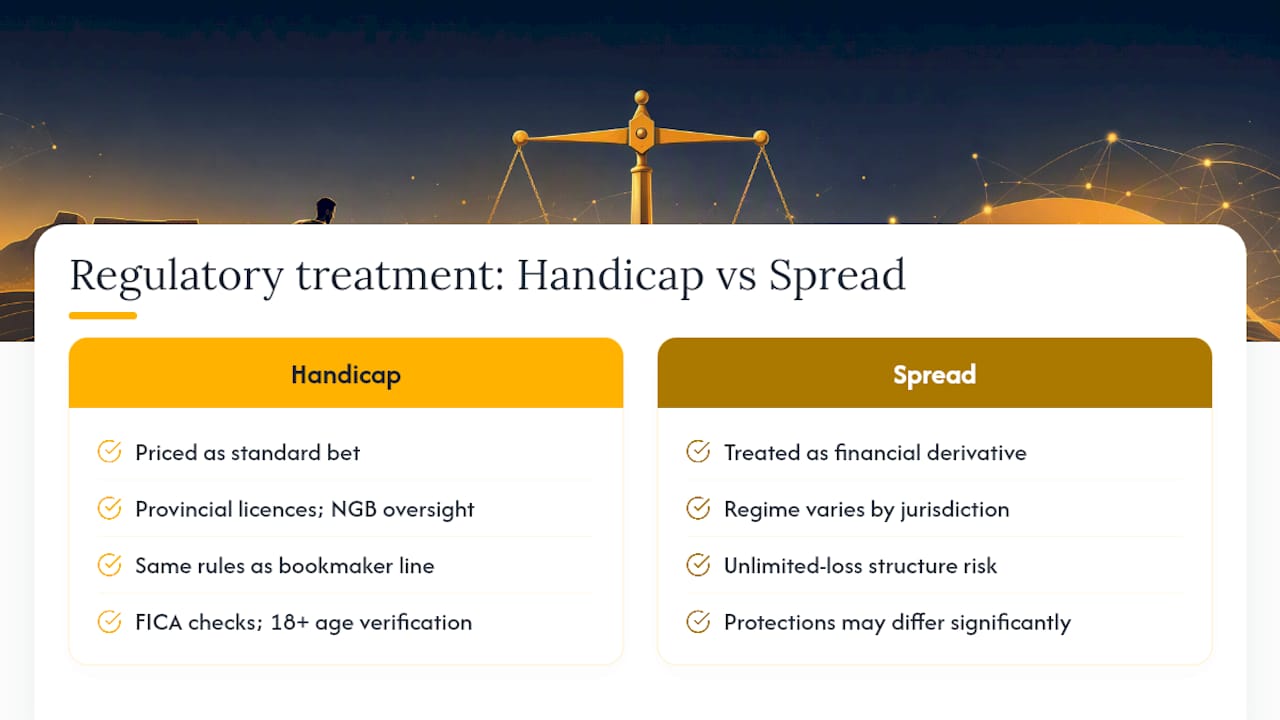
Handicap betting is legal and widely regulated wherever conventional sports betting is legal, since it’s a pricing structure on standard match outcomes rather than a distinct gambling product requiring separate licensing. In South Africa, licensed bookmakers offering handicap markets operate under provincial gambling board licenses, and the National Gambling Board oversees compliance at a national level.
The regulatory picture shifts, however, once you cross into true spread betting, which several jurisdictions treat as a financial derivative rather than a gambling product because of its unlimited-loss structure. That distinction matters if you’re comparing offers between a standard licensed bookmaker and a UK-style spread betting firm, since the consumer protections and deposit limits attached to each can differ significantly.
Age verification (18 and over in South Africa) and FICA-compliant identity checks apply to handicap markets exactly as they apply to any other bet type on a licensed platform. There’s no separate legal category or additional restriction specific to handicap betting itself; the rules that govern it are the same ones governing the bookmaker’s entire fixed-odds product line. Always confirm a site holds a valid South African license before depositing, regardless of which specific market you plan to bet.
A Working Bettor’s Take on Handicap Markets
Handicap markets reward the boring work most bettors skip: checking two or three lines instead of one, and sizing down on quarter lines where the variance is genuinely higher. That’s the whole edge, and it’s available to anyone willing to do it consistently. Our team leans on handicap markets mainly for one-sided derbies and cup mismatches, where straight-win odds barely move the needle. For deeper reference, our betting glossary and responsible gambling resources cover the terms and safeguards worth knowing before you stake real money on any adjusted line.
— Nkosi
Keep Learning: Glossary, Strategy, and Line Comparisons
Handicap betting clicks faster once you can see the terminology and the numbers side by side, rather than piecing it together bet by bet. If you hit an unfamiliar term mid-slip, the Betting Glossary breaks down South African betting language in plain terms, and it’s the fastest way to stop guessing what a quarter line or handicap tie actually means.

Bet-mzansi is built for bettors who want to compare markets before committing, not just take the first line a single app shows. Our Betting Strategy Basics guide walks through staking discipline alongside handicap-specific tactics, and our betting sites comparisons let you check how the same handicap line is priced across licensed South African bookmakers before you place a single rand. If you’re ready to see which lines are actually worth backing this week, start by comparing the Cardano Casino Hall of Fame to discover alternative deposit methods and partner promotions that could enhance your betting experience.
Sources
The core explanations and worked examples in this piece draw on Goal.com’s handicap betting guide, Flashscore’s settlement breakdown, and The Independent’s explainer on spread betting. If handicap betting or any wagering starts feeling less like entertainment and more like pressure, BeGambleAware and Gamblers Anonymous both offer free, confidential support, and eCOGRA certification is a useful signal when checking whether an operator meets independent fairness standards.