South African Lucky Numbers: Test Game Specific Picks Over 20–50 Draws
Practical lucky numbers advice for South African bettors: game-specific systems backed by NGB guidance. Test picks over 20–50 draws; stake 0.5%–2%.
For South African bettors, the smart approach to lucky numbers is a game-specific, data-informed pool of numbers picked with a repeatable system, not a birthday or a gut feeling. There is no method that beats the odds built into the game. What separates disciplined bettors from the rest is consistency, verified licensed operators, and strict bankroll control, backed by the National Gambling Board and reflected in Bet-mzansi’s own strategy guides.
TL;DR:
- Using a consistent, data-informed system to select numbers improves long-term betting discipline and avoids reliance on superstitions or birthdays.
- Strategies should be tailored specifically to each game’s number pool size, with careful tracking of recent results over at least 20 to 50 draws.
- Fixed-odds Lucky Numbers bets pay out regardless of how many others pick the same outcome, meaning the method of selection does not influence odds.
- Only licensed South African operators provide transparent draw history and odds, crucial for building and testing a reliable betting system.
- Belief in lucky numbers is rooted in psychology and culture, but it does not impact actual draw probabilities or improve chances of winning.
Table of Contents
- What Is a Lucky Numbers Guide and How Does the Betting Work?
- Which Numbers Work Best for PowerBall, Lotto, Daily Lotto, and UK 49s?
- What Hot, Cold, and Overdue Numbers Really Tell You
- How to Build a Repeatable Lucky Numbers System
- Where to Check Draw Results and Compare Licensed Operators
- Why Are Certain Numbers Considered Lucky Across Cultures?
- Why Do People Believe in Lucky Numbers at All?
- What Myths About Lucky Numbers Should You Ignore?
- What Is Numerology and How Do Numerologists Pick Numbers?
- Which Numbers Are Considered Lucky Around the World?
- Is Betting on Lucky Numbers Legal in South Africa?
- What South African Bettors Get Wrong About Lucky Numbers
- Ready to Put This Lucky Numbers Guide to Work?
- Sources
What Is a Lucky Numbers Guide and How Does the Betting Work?
Lucky Numbers is fixed-odds betting on the outcome of a real lottery draw, local or international, rather than a lottery ticket itself. You are not buying into a prize pool that gets split among winners. You are backing a specific outcome, such as a single number, a pair, a triplet, an odd/even split, or the sum of the drawn numbers, at odds the bookmaker publishes in advance.
That distinction matters for how you think about strategy. In a traditional lottery, your payout depends on how many other people picked the same numbers. In fixed-odds Lucky Numbers, your payout is locked the moment you place the bet. Two people betting the same number on the same draw both get paid in full if it hits.
South Africa regulates this at the provincial level. Operators need a license, and bodies like the Mpumalanga Economic Regulator issue many of the relevant approvals, with the National Gambling Board setting the national framework. Before you place a single rand, confirm the operator is licensed and read its specific rules. Payout tables, minimum stakes, and market types vary from one bookmaker to the next.
Common draws you’ll see offered by licensed South African operators include:
- SA PowerBall — a large-pool draw with a bonus ball, giving bigger jackpots but tougher single-number odds.
- SA Lotto (6/52) — the classic six-from-fifty-two format.
- Daily Lotto (5/36) — a smaller pool, drawn daily, with noticeably shorter odds per number.
- UK 49s — a popular international draw offered as a Lucky Numbers market by many SA-licensed sites, run twice daily.
The size of the number pool changes everything about how you should select numbers, which is the whole point of treating each game differently instead of using one system for all of them.
Which Numbers Work Best for PowerBall, Lotto, Daily Lotto, and UK 49s?
Draw size dictates strategy far more than superstition does. A method that works on a 36-number pool falls apart on a 52-number pool, and neither translates cleanly to a two-ball bonus market. Here’s how to adjust game by game.
- SA PowerBall. You’re choosing from a large main pool plus a separate PowerBall number, so odds on any single main number are long. Spread your candidate pool across the full range instead of clustering in one third of the board, and treat the bonus ball as its own separate bet with its own frequency check.
- SA Lotto (6/52). With six numbers drawn from fifty-two, a mix of high and low numbers tends to mirror actual draw patterns better than an all-high or all-low set. Guides on game structure and draw history consistently show that lopsided splits are rare in real results, so a 3-3 or 4-2 high/low balance is a sounder starting point than six numbers under 31.
- Daily Lotto (5/36). The smaller field means individual numbers repeat more often over a short run, which is exactly why Bet-mzansi’s own Gosloto-style strategy guide recommends tracking a rolling window of draws rather than relying on lifetime averages that smooth out recent patterns.
- UK 49s. Two draws a day, six main numbers plus a bonus ball, gives you a much faster feedback loop for testing a system than a once or twice weekly local draw.
Whatever the game, avoid picking numbers that only cluster around a birthday or anniversary set. In larger pools especially, an all-under-31 selection ignores nearly half the available board, and that’s before you even get to hot and cold data.
What Hot, Cold, and Overdue Numbers Really Tell You
Hot numbers are the ones drawn most often over a set stretch of history. Cold numbers are drawn least often. Overdue numbers haven’t appeared in a while relative to their normal frequency. All three come from the same source: a frequency chart built from past draw results.
Here’s the catch. A number that hasn’t appeared in 40 draws isn’t “due” in any mathematical sense. Each draw is independent, and treating a cold streak as pressure building toward a hit is a classic gambler’s fallacy. What frequency data is genuinely useful for is narrowing a candidate pool and spotting pairs or triplets that show up together more than random chance would predict, not predicting the next draw with certainty.
The National Gambling Board is direct about this limitation: statistical methods used by bettors and published in guides do not guarantee outcomes and remain subject to sample noise, especially over short stretches.
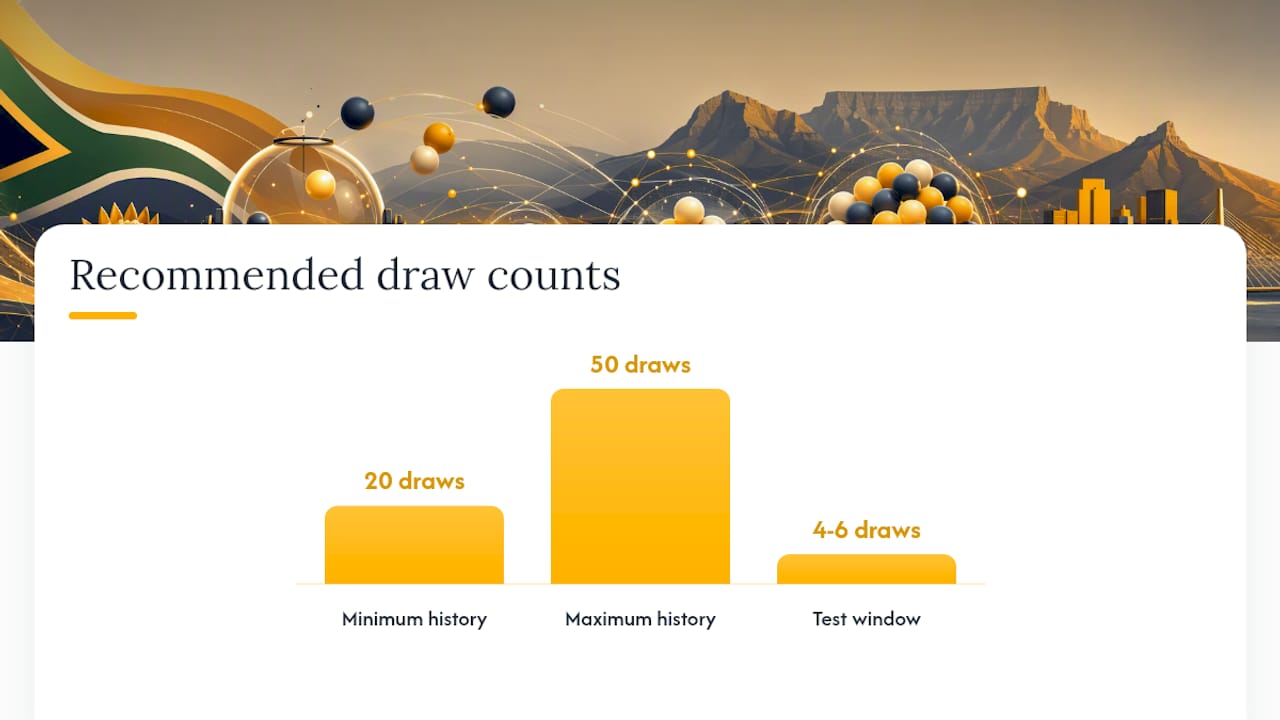
Pro Tip: Pull frequency data over at least 20 to 50 draws before drawing any conclusion. Anything shorter is closer to noise than signal, and you’ll end up chasing patterns that don’t repeat.
A simple, low-drama workflow:
- Pull the last 20 to 50 results for your chosen game.
- Rank numbers by frequency and flag the top and bottom quartiles.
- Cross-check pairs and triplets that recur, not just single numbers.
- Build your candidate pool from that shortlist, not the full board.
- Run it across 4 to 6 draws before you touch the method again.
How to Build a Repeatable Lucky Numbers System
Consistency beats reinvention. Bet-mzansi’s own guidance on smart-play strategy for 5/36 games makes the same point: bettors who stick with one method long enough to judge it fairly do better than those who switch after every miss.
- Pick one game and stay there. Splitting attention across PowerBall, Lotto, and Daily Lotto at once makes it impossible to tell what’s actually working.
- Build a candidate pool of 10 to 15 numbers using the hot/cold/overdue workflow above, sized to the game’s number range.
- Apply one rule set. Decide your high/low balance and pair logic once, then use it for a defined stretch. No mid-run edits.
- Stake as a fixed percentage of your bankroll, not a fixed rand amount. A conservative range of 0.5% to 2% per bet keeps a bad run from doing real damage.
- Review after a set number of draws, not after every loss. Judge the system over 15 to 20 draws minimum before deciding it isn’t working.
Pro Tip: If your bankroll is R1,000, a 1% stake is R10 per bet. That feels small, but it lets you survive 20 losing draws in a row without touching half your bankroll, which is what actually lets you evaluate a system fairly.
Retire a system only after it’s had a fair sample size to prove itself, not after two or three unlucky draws.
Where to Check Draw Results and Compare Licensed Operators
You need real draw history, not guesswork, to run any of the workflows above. Licensed South African operators typically publish historic results and odds for their Lucky Numbers markets, and that data is exactly what you should be pulling for frequency charts.
- Draw-history exports and in-platform filters on licensed betting sites let you isolate a specific game’s last several months of results.
- Bet-mzansi’s comparison of the best sites for Lucky Numbers markets breaks down which operators present odds and markets most clearly for UK 49s and Gosloto-style games.
- Bet-mzansi’s tips and predictions hub rounds up short-form analysis you can cross-check against your own frequency work.
Always confirm an operator’s provincial license before depositing, and keep the National Responsible Gambling Programme helpline handy if betting stops feeling like entertainment.
Why Are Certain Numbers Considered Lucky Across Cultures?
Long before fixed-odds betting existed, entire societies were assigning meaning to numbers. In Chinese tradition, 8 is prized because it sounds close to the word for prosperity, which is why Cantonese speakers pay real money for phone numbers and license plates containing it. Four gets the opposite treatment across much of East Asia because it echoes the word for death, and many buildings skip the fourth floor entirely.
Western superstition leans hard on seven, tied to religious and calendar significance stretching back to ancient Babylon, where astronomers tracked seven visible celestial bodies. Thirteen carries the reverse reputation in much of Europe and North America, linked to folklore around the Last Supper and medieval superstition, strong enough that some hotels still skip labeling a thirteenth floor.
Closer to home, South Africa’s own mix of cultural traditions layers in numerology brought from Indian, Christian, and indigenous belief systems, often blending with personal significance like a birth date or a jersey number worn by a favorite player. None of this history changes the math behind a draw. A number’s cultural weight in Cape Town or Durban has zero bearing on whether it comes up in tonight’s PowerBall draw. It’s worth knowing where the instinct comes from, mostly so you can recognize when you’re picking a number for a story rather than for a reason.
Why Do People Believe in Lucky Numbers at All?
Belief in lucky numbers comes from a well-documented quirk in how human brains process randomness: we are pattern-seeking by default, even when the pattern isn’t there. Psychologists call part of this the clustering illusion, where a short run of coincidences (a number hitting twice in a week, a birthday number landing on a big win) gets read as a meaningful signal rather than what it usually is, plain chance.
There’s also a control angle. Picking a number yourself, especially one tied to a memory or a belief, creates a feeling of agency over an outcome that is, mechanically, entirely outside your control. That feeling isn’t irrational to want. It’s just worth separating from the actual math of the draw.
This matters practically because it shapes bad habits. A bettor emotionally attached to a “lucky” set of numbers is far more likely to keep betting them after a long losing stretch, doubling down on sentiment instead of stepping back to check whether the numbers are actually performing. That’s the exact moment discipline and a predefined review point, like the 15 to 20 draw threshold covered earlier, matter more than instinct.
Recognizing the pull of a lucky number for what it is, a comfort mechanism rather than a predictive tool, is the first real step toward betting with your head instead of your gut.
What Myths About Lucky Numbers Should You Ignore?
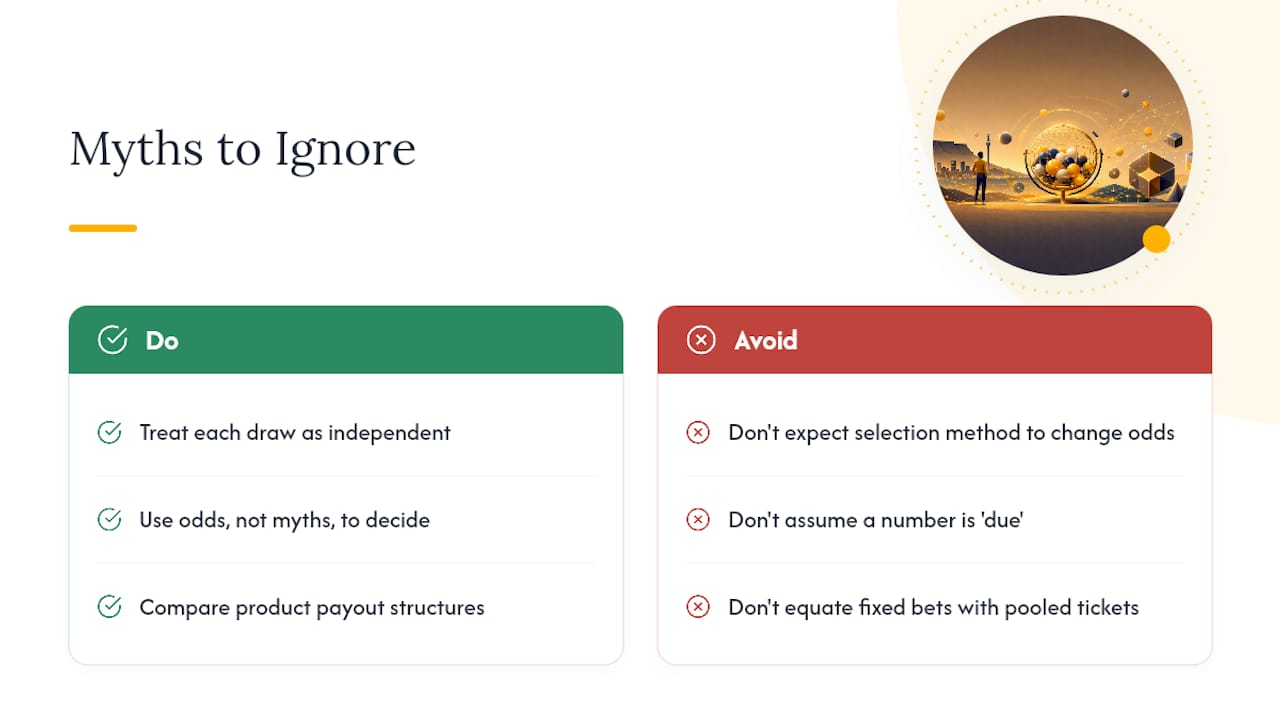
The biggest myth is that any number selection method changes the underlying odds of a fixed draw. It doesn’t. Whether you pick numbers from a frequency chart, a birthday, or a dartboard, the draw mechanism doesn’t know or care how you chose your numbers.
A second common myth is that a number “due” to hit is statistically more likely to appear soon. Each draw is an independent event. A number absent for 60 draws carries exactly the same odds on draw 61 as a number that hit last week, a point the NGB’s guidance on statistical methods makes clear when it comes to sample noise and overreliance on short-term patterns.
A third myth worth killing is that fixed-odds Lucky Numbers betting and buying a lottery ticket carry the same risk-and-reward structure. They don’t. A lottery ticket pays out from a shared prize pool that shrinks as more winners split it. A Lucky Numbers bet pays a fixed rate set by the operator before the draw happens, which is a meaningfully different product even when it’s based on the same underlying draw.
Finally, there’s a persistent idea that “everyone knows” certain numbers are luckier globally, like 7 or 3. Cultural popularity of a number has no statistical relationship to how often it’s drawn in any specific lottery. If a number gets picked more often by bettors, that changes nothing about the draw itself, though it can occasionally affect payout structures on markets where odds shift with betting volume.
What Is Numerology and How Do Numerologists Pick Numbers?
Numerology is a belief system that assigns meaning to numbers based on things like your birth date, the letters in your name, or significant dates in your life. Practitioners typically reduce a birth date to a single “life path number” through repeated digit addition, then attach personality traits and lucky associations to that result.
Some bettors borrow numerology’s simple math, converting a birthday or name into a number, as a source for their picks. There’s nothing wrong with using it as a personal ritual if it makes betting more enjoyable. What’s worth being clear about is that numerology has no connection to how lottery draws are generated. Draw machines and random number generators used by licensed operators don’t reference anyone’s birth chart.
If you want a system with an actual statistical basis, frequency charts and pair analysis, covered earlier in this guide, are grounded in the real draw history of the specific game you’re playing. Numerology-derived numbers can absolutely sit alongside that data as a personal preference. They just shouldn’t replace the game-specific structure and bankroll discipline that determine whether your betting stays sustainable.
Which Numbers Are Considered Lucky Around the World?
Different regions gravitate toward different numbers, and the reasons are almost always cultural rather than mathematical. Seven shows up repeatedly across Western, Christian, and Islamic traditions, often tied to creation stories or sacred cycles. Eight dominates in Chinese-influenced markets for its phonetic link to wealth. Nine holds strong positive associations in Japan for pronunciation reasons distinct from China’s number beliefs, while carrying negative weight in some other East Asian contexts for the opposite reason.
Three appears widely across Western storytelling and religious tradition (the trinity, three wishes, three acts), giving it a reputation as a balanced, complete number. In parts of Africa, including South Africa, certain numbers carry personal or family significance tied to birth order, clan traditions, or dates of major life events rather than a single dominant national belief, making lucky-number preferences here more individually varied than in markets with one dominant cultural narrative.
None of this changes a single thing about how PowerBall, Lotto, or UK 49s draws are generated. It’s useful context for understanding why a friend swears by 8 and another swears by 7, and it’s genuinely interesting history. It just isn’t a betting strategy, which is why the game-specific data techniques earlier in this guide matter more if you’re actually trying to bet with an edge.
Is Betting on Lucky Numbers Legal in South Africa?
Lucky Numbers betting is legal in South Africa when it’s offered by an operator holding a valid provincial gambling license, with the National Gambling Board setting the national regulatory framework and provincial bodies handling licensing directly. Betting through an unlicensed platform, including many offshore sites marketed heavily online, sits outside that legal protection and offers you no recourse if a dispute arises over payouts.
There’s an ethical dimension too, separate from the legal one. Because Lucky Numbers markets get compared to numerology and superstition so often, there’s a temptation for content and marketing around the product to lean on lucky-number folklore rather than being straightforward about the fact that this is fixed-odds wagering on real draw outcomes. Responsible promotion means being upfront that no number selection method changes the underlying odds, and that any guide, including this one, is describing a framework for organizing your bets, not a system that beats the house edge.
Bettors carry responsibility too. Sticking to licensed operators, understanding that draw outcomes are genuinely random, and applying the bankroll discipline covered earlier are the practical, ethical baseline for playing Lucky Numbers markets in a way that stays enjoyable rather than becoming a problem.
What South African Bettors Get Wrong About Lucky Numbers
Most South African bettors I see get one thing backward: they treat number selection as the strategy, when bankroll discipline is the actual strategy. A sharp candidate pool built from real frequency data means nothing if you blow through your bankroll chasing a cold streak on draw four instead of draw twenty.
The pattern I’d flag for readers using Bet-mzansi’s guides is that game-specific thinking beats generic thinking every time. What works on a 5/36 Daily Lotto pool doesn’t transfer cleanly to a 6/52 Lotto board, and treating them the same is where a lot of promising systems fall apart early.
Bet responsibly and only with funds you can afford to lose. If gambling stops feeling fun, contact the National Responsible Gambling Programme.
— Nkosi
Ready to Put This Lucky Numbers Guide to Work?
Reading about frequency charts and stake percentages only gets you so far. The next step is checking actual draw history and finding an operator that presents Lucky Numbers markets clearly, with transparent odds on singles, pairs, and triplets instead of burying the details.

Bet-mzansi is the practical next stop for exactly that. Our comparison of licensed sites for Lucky Numbers betting breaks down which operators handle UK 49s and Gosloto-style markets best, so you’re not guessing which platform actually shows odds you can act on. Pair that with our bankroll management guide before you place a single bet, and check the full site for current draw results and bookmaker reviews. Start by picking one licensed operator from our comparison, set your stake percentage, and run your first tracked stretch of draws this week.