Odds Boosts Explained: +EV Checklist for South African Bettors
Spot +EV odds boosts. Check stake caps and payout form, read the fine print, and use Bet-mzansi's checklist to choose boosts worth betting.

An odds boost is a temporary increase to the payout price on a specific bet, offered by a sportsbook to make that wager pay more than its normal odds would. A bigger number does not mean a better bet: the outcome is exactly as likely to happen as before, so the only question worth asking is whether the new price still gives you positive expected value once you check the stake cap and terms.
TL;DR:
- Most boosts range from 10% to 40%, but their value depends on stake caps, payout method, and whether winnings are cash or credit.
- Recognize that boosted odds do not change the probability of an outcome but only the payout for a correct prediction.
- Always compare the boosted price to the original odds to assess if the expected value justifies the bet, considering your own probability estimates.
- Be cautious of stake limits, bonus restrictions, and regional or account restrictions that can limit the actual benefit of the boost.
- Avoid chasing boosts without a clear mathematical edge, and focus on disciplined evaluation rather than marketing hype.
Table of Contents
- Odds Boost Explained: The Basic Mechanics
- How Odds Boosts Reach You and What Happens at Settlement
- The Main Types of Boosts You’ll See
- Terms and Stake Limits That Quietly Change the Value
- A Quick Framework for Judging Whether a Boost Is Worth It
- Strategies That Work and the Traps Most Bettors Fall Into
- Where Boosts Show Up and Which Sports Feature Them Most
- How Bet-mzansi Evaluates Boosts Before Recommending Them
- The One Rule Worth Remembering
- Why Most Bettors Judge Boosts Backwards
- Sources
Odds Boost Explained: The Basic Mechanics
An odds boost takes a bet the sportsbook already offers and republishes it at a higher price for a limited time. If a team is priced at +150 to win, a book might boost that same outcome to +200 for a few hours or a single matchday. Nothing about the game changes. Only the number attached to a correct guess does, and that’s the part bettors most often misread.
Books run these promotions for one reason: engagement. A boosted price pulls in bets on markets a sportsbook wants traffic on, whether that’s a marquee Saturday matchup or a slow Tuesday slate that needs action. Boosted odds typically raise a payout by roughly 10% to 40%, though headline “super boosts” occasionally go further for a single, heavily marketed event.
The distinction that matters most:
- Odds are a price, not a probability. A boost changes what you’re paid, not how often the bet wins.
- The house edge baked into the original line usually still exists inside the boosted price, just shrunk.
- A boost on a bad bet is still a bad bet, only slightly less bad.
How Odds Boosts Reach You and What Happens at Settlement
Sportsbooks deliver boosts two main ways, and knowing which one you’re looking at changes how you use it.
- Pre-set boosted markets. The book publishes an already-enhanced price in a dedicated “boosts” or “enhanced odds” tab. You click it and bet like normal, no extra step required.
- Boost tokens. You’re issued a token or credit through a promotion, loyalty program, or app notification. You apply it manually to a bet slip before placing the wager, and it usually expires within a set window, often 24 to 72 hours.
An odds boost typically replaces the standard odds for a specific market once applied, meaning the bet settles at the enhanced price rather than the original line, assuming you stayed inside the stake limit.
Here’s a simple side-by-side. A $20 bet at standard odds of +150 pays $50 in profit. Boosted to +200, that same $20 stake pays $40 in profit, a real gain, but only if the stake cap lets you bet the full $20 and the payout comes as cash rather than site credit. Always check both before assuming the math holds.
The Main Types of Boosts You’ll See
Not every boost works the same way, and recognizing the type tells you how to evaluate it.
- Single-market boosts. A specific player prop or match outcome gets a price bump, like a striker’s odds to score boosted from +120 to +160.
- Same-game parlays and multi-leg boosts. Combining several outcomes from one event into a boosted price. Odds climb fast because you’re multiplying several probabilities together, and the payout jump can look dramatic while the actual chance of hitting drops just as fast.
- Profit boosts vs. odds boosts. A profit boost increases your winnings by a flat percentage after the bet settles, while an odds boost changes the price itself before you place the wager. They look similar but calculate differently.
- Event-specific “super boosts.” Tied to a single high-profile fixture, like a cup final or marquee tennis match, and usually capped at a low stake because the book expects heavy volume.
Boost size clusters mostly in that same 10% to 40% range regardless of type, which means a same-game parlay boosted from +800 to +1,000 has moved less, proportionally, than the sticker shock suggests.
Terms and Stake Limits That Quietly Change the Value
The fine print on a boost often matters more than the boosted number itself.
- Maximum stake caps. Books commonly limit boosted bets to somewhere between $10 and $100, depending on the size of the enhancement and how much exposure the book wants to take on.
- Payout form. Some promotions pay winnings as cash. Others settle in site credit or free-bet tokens, which carries its own restrictions on withdrawal or reuse.
- Non-combinability. Boosted bets frequently can’t be paired with other bonuses, cashout features, or same-game parlay builders.
- Account and geography restrictions. New-customer-only boosts, region locks, and short expiry windows are standard, and missing the window forfeits the offer entirely.
Pro Tip: Before tapping “place bet,” screenshot both the boosted odds and the stake cap. Terms occasionally get updated mid-promotion, and having your own record protects you if a payout comes in lower than expected.
A Quick Framework for Judging Whether a Boost Is Worth It
Run any boost through this four-step check before you commit money to it.
- Measure the boost size. Compare the boosted price directly against the standard market price for that same outcome, not against what you assume the standard price is. Books that display both the original and boosted odds make this easy; if a book hides the base price, treat that as a warning sign.
- Build your own probability estimate. Ignore the sportsbook’s implied probability for a moment and ask what you genuinely think the odds of that outcome are, based on form, injuries, or matchup data.
- Calculate expected value. Multiply your estimated win probability by the boosted payout, then subtract the probability of losing multiplied by your stake. A positive number means the boost has positive expected value, or +EV, and is worth considering.
- Weigh the stake cap against your bankroll. A boost capped at $20 delivers a fixed, small edge no matter how good the price looks, so factor in whether your time and attention are better spent on a bet without a stake ceiling.
Your estimate beats the market’s break-even threshold, which signals +EV, assuming your probability read is accurate and the stake cap doesn’t gut the payoff. Use a resource like BetMzansi’s guide on how betting odds work if converting between odds formats and implied probability still feels unfamiliar.
Pro Tip: If you can’t confidently estimate a probability for the outcome, skip the boost. Guessing at the math defeats the entire point of running the numbers.
Strategies That Work and the Traps Most Bettors Fall Into
Sharp bettors treat boosts as one input, not a reason to bet on its own. Some boosted markets create brief arbitrage windows where hedging against another book locks in a small profit regardless of outcome, but stake caps, timing, and the hassle of managing multiple accounts limit how often that’s practical for casual bettors.
Watch for these common pitfalls:
- Selective display. A boost highlighted in bright colors with a countdown timer is a marketing tool. Urgency framing is designed to short-circuit the math check you should be running.
- Chasing losses through boosts. Treating a string of boosted bets as a way to recover previous losses turns a pricing quirk into a bankroll problem. Accumulator-style boosts are especially prone to this because the payout headline distracts from the compounding risk.
Pro Tip: Keep a simple log of every boost you take: stake, odds, outcome. Patterns show up fast, including whether a particular book keeps steering you toward bets that lose more than they should.
Where Boosts Show Up and Which Sports Feature Them Most
Boosts live in a dedicated “Boosts” or “Enhanced Odds” tab inside most sportsbook apps and websites, usually one tap from the homepage. Email alerts and social media accounts are the other major channel, particularly for one-off “super boosts” tied to a single big event.
Football and soccer see the heaviest volume of boosts, followed by horse racing, tennis during Grand Slam weeks, and combat sports around major cards. Timing follows demand: weekends, derbies, and finals draw the biggest and most frequent boosts, since that’s when betting volume peaks. If you’re scanning for value across markets, a resource like Raffle Genius’s roundup of strong odds this week is a useful supplementary check outside your usual book.
How Bet-mzansi Evaluates Boosts Before Recommending Them
Bet-mzansi checks four things on every boosted offer: the gap between base and boosted price, the maximum stake allowed, whether winnings pay as cash or credit, and how often that specific book runs the promotion versus using it as a one-time hook.
- Comparing boosted odds against a book’s standing lines to spot real value versus cosmetic markup.
- Verifying stake caps and payout form directly from the terms, not the promotional banner.
- Cross-referencing definitions in the BetMzansi betting glossary so unfamiliar terms in the fine print don’t slip past readers.
That same groundwork feeds the site’s broader learning resources and accumulator guides for bettors building out a full strategy.
Ready to see boosts in action? Compare current offers across licensed South African bookmakers and check each one’s terms before you commit a stake. For a plain-language refresher on how prices translate into implied probability, the guide to how betting odds work is the right place to start, and the responsible gambling page is worth a look before you size any bet, boosted or not.
The One Rule Worth Remembering
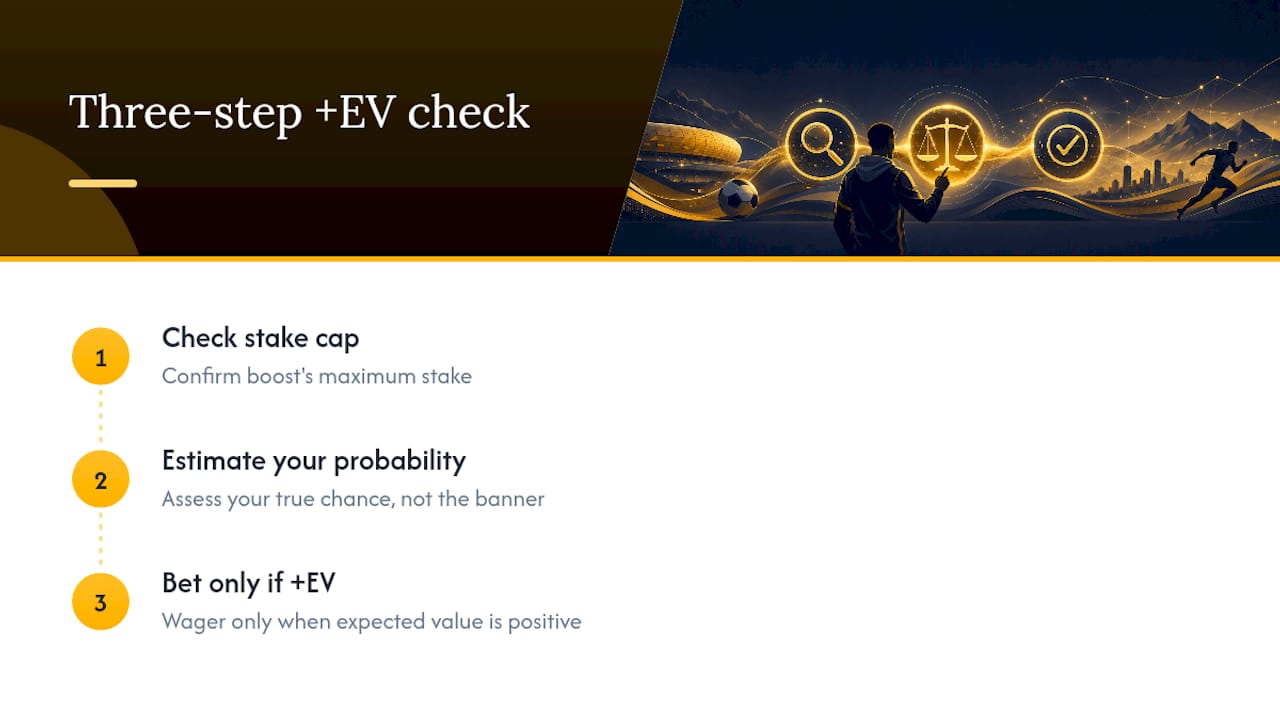
Treat every boost as a math problem before a marketing offer: check the stake cap, estimate your own probability, and only bet when the numbers say +EV, not the banner.
Why Most Bettors Judge Boosts Backwards
The biggest mistake bettors make with boosts isn’t math, it’s sequencing. Most people see the enhanced price first and reverse-engineer a reason to like the bet. That’s backwards. The probability estimate has to come before you even look at the boosted number, or you’re just rationalizing a bet you already wanted to make.
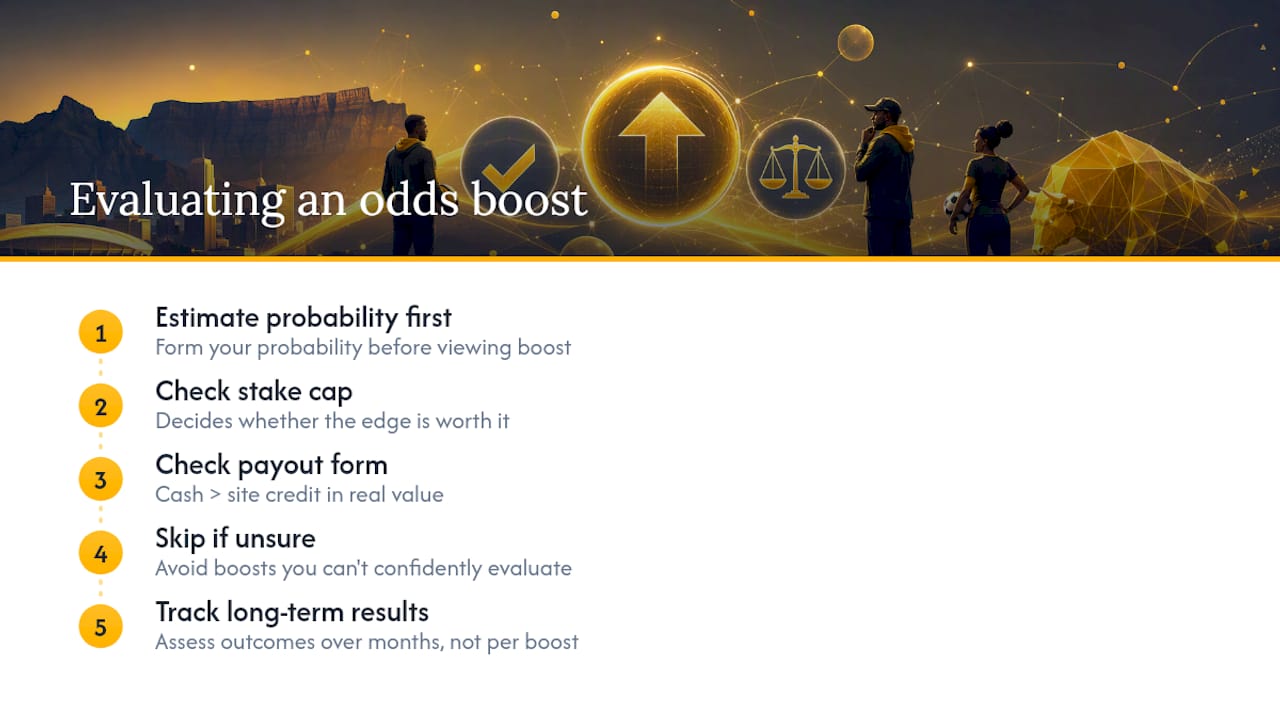
Conventional advice tells bettors to “always check the terms,” which is true but useless as stated. The terms that matter are narrow: the stake cap, because it determines whether the edge is even worth your time, and the payout form, because a boost paid in site credit is worth meaningfully less than one paid in cash. Everything else in the fine print is noise by comparison.
What’s overrated: chasing every boost a book pushes to your phone. What’s underrated: the discipline of skipping a boost entirely when you can’t form a confident probability estimate. A boost you can’t evaluate isn’t a free look, it’s a bet you’re taking on faith. Bettors who track outcomes over months, rather than judging each boost in isolation, are the ones who actually benefit from these promotions instead of just being marketed to by them.
— Nkosi
Sources
- How Odds Boosts Work & How to Take Advantage of Them | Odds Assist
- Odds boosts expert guidance | VegasInsider